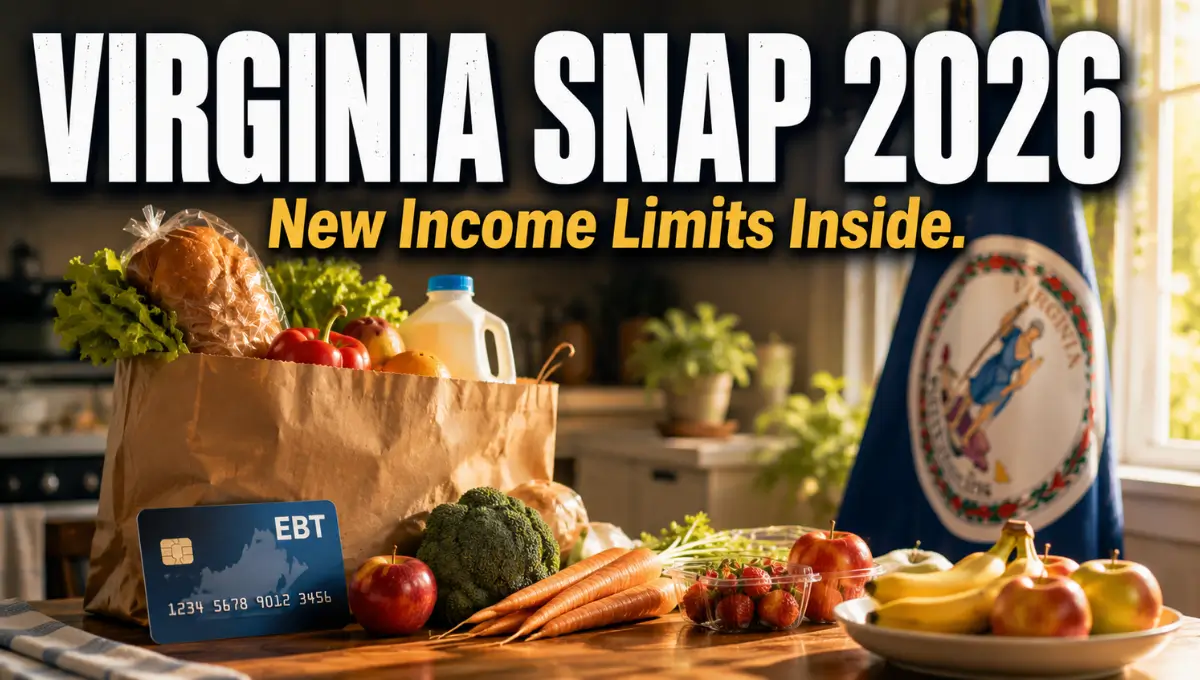
If you’re wondering whether your household can get food stamps in Virginia this year, here’s the short answer. For fiscal year 2026 (October 1, 2025 – September 30, 2026), most Virginia households qualify with a gross monthly income at or below 200% of the Federal Poverty Level. There’s also no asset limit for most applicants.
Virginia uses a policy called Broad-Based Categorical Eligibility, or BBCE. This lets more families qualify than the standard federal rules allow. A single person can earn close to $2,610 a month and still be eligible. A family of four can earn up to roughly $5,360 a month.
Some rules are changing in 2026 too. Work requirements are expanding for older adults, and a new food purchase restriction is coming later in the year. This guide breaks down the income limits, benefit amounts, and new rules in plain language, so you know exactly where you stand.
Article Summary
- Gross income limit for most households: 200% of the Federal Poverty Level
- 1-person household limit: about $2,610/month; 4-person household limit: about $5,360/month
- Maximum monthly benefit: $298 for one person, up to $994 for a family of four
- No asset limit for most applicants under BBCE
- Work requirements expand to adults age 55–64 starting February 1, 2026
- Standard applications are processed in 30 days; expedited cases in 7 days
What Is SNAP and How Does It Work in Virginia?
SNAP stands for the Supplemental Nutrition Assistance Program. It helps low-income households buy groceries using an EBT card. In Virginia, the program is run by the Department of Social Services through the CommonHelp online portal.
Eligibility depends on your income, household size, and a few other factors like work status and residency. Virginia’s rules are more generous than the federal minimum, thanks to BBCE. That means many working families who wouldn’t qualify in other states may still qualify here. If you want to see how Virginia compares, our guide to SNAP income limits by state 2026 breaks down the differences.
Virginia SNAP Income Limits for 2026
Income is the biggest factor in SNAP eligibility. Virginia checks two numbers: your gross income and your net income. Gross income is what you earn before any deductions. Net income is what’s left after allowed deductions, like rent or child care costs.
Most households only need to worry about the gross income test. But if your household has a member who is 60 or older, or has a disability, you skip the gross income test. You only need to meet the net income limit, which is set at 100% of the Federal Poverty Level.
Gross Income Limits by Household Size
These figures apply from October 1, 2025 through September 30, 2026, and reflect the 200% FPL threshold most Virginia households must meet.
| Household Size | Estimated Gross Monthly Income Limit |
|---|---|
| 1 person | ~$2,610 |
| 2 people | ~$3,526 |
| 3 people | ~$4,442 |
| 4 people | ~$5,360 |
| Each additional person | +~$918 |
Your exact limit may vary slightly depending on rounding and annual poverty guideline updates. For a full size-by-size breakdown alongside other states, see our Virginia SNAP income limits 2026 page.
Net Income Limit
The net income limit is set at 100% of the Federal Poverty Level. This applies to all households, but it’s the only income test for households with an elderly or disabled member. Deductions that lower your net income include:
- A standard deduction based on household size
- Earned income deduction (20% of gross wages)
- Dependent care costs
- Excess shelter costs, like rent and utilities
- Medical expenses for elderly or disabled members
Because deductions vary so much by household, the easiest way to check your own number is with a SNAP eligibility calculator in 2026 rather than trying to do the math by hand.
Asset and Resource Limits
Most Virginia SNAP applicants don’t need to worry about savings, bank accounts, or vehicles at all.
Thanks to BBCE, there is no asset limit for most households. This is one of the biggest advantages of Virginia’s SNAP program compared to states that still use strict asset tests.
When Asset Limits Still Apply
Asset limits only come back into play for a specific group: households where a member has been disqualified, for example due to an Intentional Program Violation or a work-rule sanction. In those cases, standard federal limits apply.
| Household Type | Asset Limit |
|---|---|
| Standard disqualified household | $2,750 |
| Household with elderly or disabled member | $4,250 |
If this doesn’t apply to your household, you can generally ignore asset limits entirely when applying.
Maximum SNAP Benefit Amounts for 2026
Your actual benefit depends on your net income and household size. Virginia uses a formula that subtracts 30% of your net income from the maximum allotment for your household size. The table below shows the maximum amount, meaning the highest benefit a household of that size can receive.
| Household Size | Maximum Monthly Benefit |
|---|---|
| 1 person | ~$298 |
| 2 people | ~$547 |
| 4 people | $994 |
| 8 people | $1,789 |
| Each additional person | +$218 |
Most households receive less than the maximum, since the amount is reduced based on your net income. A caseworker can give you an exact figure once your application is processed.
New Rules and Changes for 2026
Two significant changes are affecting Virginia SNAP recipients in 2026. Both are worth understanding before you apply, since they could affect your benefits or how you use your EBT card.
Sweetened Beverage Purchase Restriction
Virginia received federal approval to remove certain sweetened beverages from the list of items SNAP can buy. This restriction was originally set to start April 1, 2026, but the Virginia Department of Social Services has delayed full implementation to October 2026.
When it takes effect, the restriction will apply specifically to sweetened carbonated drinks, such as soda, diet and zero-sugar soda, and carbonated energy drinks. Non-carbonated sweetened drinks, like juice, sweetened tea, and flavored milk, are expected to remain eligible. Because timelines can shift, check the Virginia DSS website for the latest confirmed date before assuming the rule is active.
Expanded Work Requirements
Starting February 1, 2026, work requirements are expanding for Able-Bodied Adults Without Dependents, commonly called ABAWDs. Previously, these rules applied mainly to adults aged 18 to 54. The requirement now extends to adults aged 55 to 64 as well.
Unless exempt, affected individuals must work, volunteer, or participate in an approved training program for at least 80 hours per month to keep their benefits. This expansion also affects homeless veterans and veterans of all ages, who are now subject to the same work rules unless they qualify for an exemption.
Common exemptions include having a disability, being pregnant, caring for a child under a certain age, or living in an area with a work requirement waiver. If you’re unsure whether you’re exempt, your local DSS office can confirm your status.
How to Apply for SNAP in Virginia
Applying for SNAP in Virginia takes a few steps. Here’s the process from start to finish.
- Gather your documents. You’ll need photo ID, proof of income, proof of residency, and information about household expenses like rent and utilities.
- Apply online, by phone, or in person. Use the CommonHelp portal at commonhelp.virginia.gov, call your local Department of Social Services office, or visit in person.
- Complete an interview. Most applicants complete a phone interview with a caseworker after submitting their application.
- Wait for a decision. Standard applications are processed within 30 days.
- Check for expedited processing. If your household has less than $150 in monthly income and under $100 in cash, you may qualify for expedited benefits within 7 days.
- Receive your EBT card. Approved households get a Virginia EBT card in the mail, which is used like a debit card at grocery stores.
Federal vs. State Rules: Why Virginia Is Different
SNAP is a federal program, but each state has some flexibility in how it’s run. The federal minimum gross income limit is 130% of the Federal Poverty Level. Virginia raises that to 200% through BBCE, which is a state-level policy choice approved under federal guidelines.
This means a household that wouldn’t qualify under the federal standard might still qualify in Virginia. It’s a good reminder that SNAP rules can look very different depending on where you live, so information from another state’s program won’t always apply here.
Frequently Asked Questions
What is the income limit for SNAP in Virginia in 2026?
Most households must have gross monthly income at or below 200% of the Federal Poverty Level. For a single person, that’s about $2,610 a month. Limits rise with household size.
Is there an asset limit for Virginia SNAP?
No, not for most households. Virginia’s BBCE policy removes the asset test for typical applicants. Asset limits only apply to households with a disqualified member.
How much can I get in SNAP benefits in Virginia?
The maximum benefit is $298 a month for one person and $994 for a family of four. Your actual amount depends on your net income after deductions.
When do the new SNAP work requirements start in Virginia?
Expanded work requirements for adults aged 55 to 64 begin February 1, 2026. Affected individuals must work or train at least 80 hours a month unless exempt.
Can I still buy soda with SNAP in Virginia?
Yes, for now. The sweetened carbonated beverage restriction was delayed from April 2026 to October 2026. Check the Virginia DSS website for the latest confirmed effective date.
How long does it take to get approved for SNAP in Virginia?
Standard applications take up to 30 days. Households with very low income and cash on hand may qualify for expedited processing within 7 days.
What to Do Next
If your household’s income looks close to these limits, it’s worth applying. Many Virginia families qualify even when they assume they won’t. Start your application through CommonHelp, or contact your local Department of Social Services office to talk through your specific situation.
This article was last updated in July 2026 based on information from the Virginia Department of Social Services and the USDA Food and Nutrition Service. Program rules can change, so confirm current details with official sources before applying.
Sources: