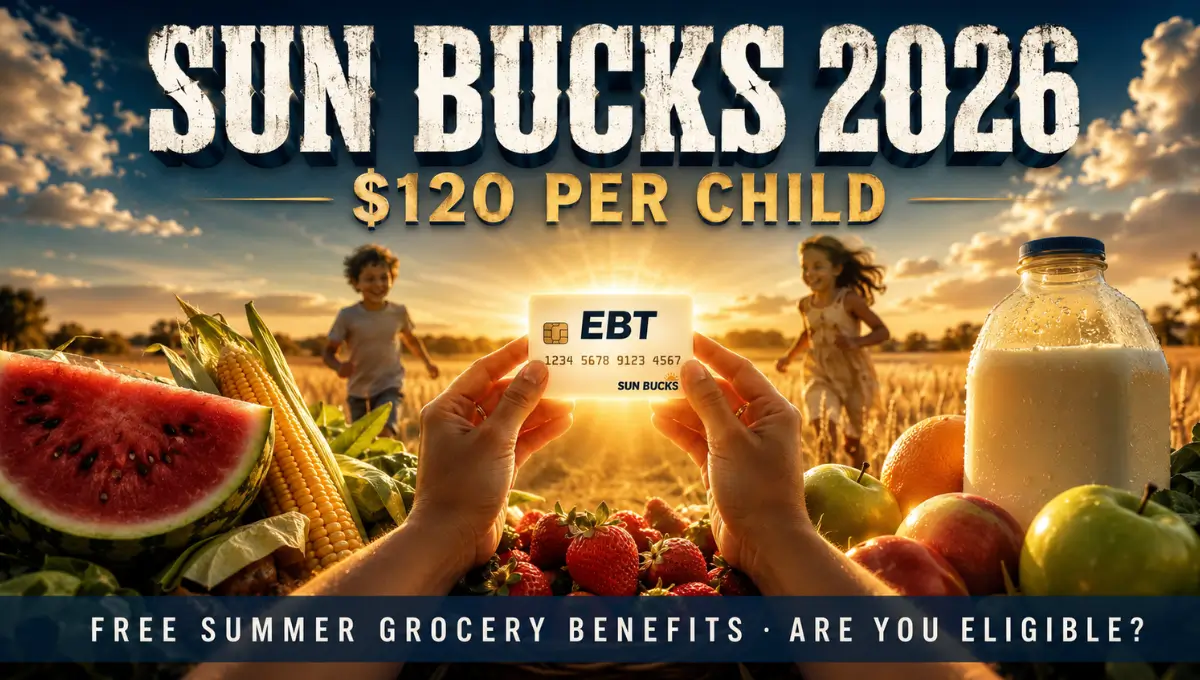
Your child may qualify for $120 in free grocery benefits this summer through SUN Bucks 2026. The program helps families buy food when school is out and school meals are no longer available.
Most families don’t need to do a thing. If your household already receives SNAP, TANF, or Medicaid, your school-age children are likely enrolled automatically. No application needed.
If you don’t receive those benefits, you may still qualify — and you have until August 31, 2026 to apply. This guide covers everything you need to know: who qualifies, income limits, which states are participating, and how to apply step by step.
Information last verified: June 2026 | Official source: USDA Food and Nutrition Service
Page Contents
- 1 Quick Summary
- 2 What Is SUN Bucks?
- 3 SUN Bucks 2026 Benefit Amount
- 4 SUN Bucks 2026 Eligibility Requirements
- 5 Which States Are Participating in SUN Bucks 2026?
- 6 SUN Bucks 2026 Payment Dates by State
- 7 How to Apply for SUN Bucks 2026
- 8 How to Use Your SUN Bucks EBT Card
- 9 Important Rules Every Family Should Know
- 10 Frequently Asked Questions About SUN Bucks 2026
- 10.1 Q: How much does SUN Bucks pay per child in 2026?
- 10.2 Q: Do I need to apply if my family already receives SNAP?
- 10.3 Q: What is the income limit for SUN Bucks 2026?
- 10.4 Q: My state is not participating. Is there any way to still get benefits?
- 10.5 Q: When will I receive my SUN Bucks EBT card or payment?
- 10.6 Q: Can I use SUN Bucks at a farmers market?
- 11 Find Help Near You
- 12 Official Government Sources
- 13 What to Do Right Now
Quick Summary
- Benefit amount: $120 per eligible child ($189 in Hawaii; $180 in U.S. territories)
- Income limit: At or below 185% of the federal poverty level (FPL)
- Family of 4 income cap: $61,050 per year
- Auto-enrolled: Children in SNAP, TANF, FDPIR, Medicaid, or free/reduced school meals households
- Application deadline: August 31, 2026 (most states)
- Participating: 39+ states, Washington D.C., and 4 U.S. territories
- Not participating: Alaska, Florida, Georgia, Idaho, Indiana, Mississippi, South Carolina, South Dakota, Tennessee, Texas, and Utah
What Is SUN Bucks?
SUN Bucks is a permanent federal nutrition program managed by the USDA Food and Nutrition Service. Congress made it permanent law in 2024 under Public Law 117-328. Before that, it operated as a pilot called Summer EBT.
The mission is straightforward. Over 30 million children rely on free or reduced-price school meals during the school year. When summer arrives, that food source disappears. SUN Bucks fills that gap with grocery money that families can use at any SNAP-authorized store.
Benefits go onto an EBT card — the same card used for SNAP. You can use it at grocery stores, supermarkets, farmers markets, and even some online retailers for delivery or curbside pickup.
To understand how SUN Bucks fits into the broader summer food landscape, read our full overview in the SUN Bucks 2026 program guide — covering state timelines, benefit rollout schedules, and program history.
SUN Bucks 2026 Benefit Amount
Each eligible child receives a total of $120 for the summer. Some states load the full $120 at once. Others break it into three monthly payments of $40 each — in June, July, and August (California follows this structure).
| Location | Benefit Per Eligible Child |
|---|---|
| Most U.S. states | $120 total |
| Hawaii | $189 total |
| U.S. territories (Guam, Puerto Rico, CNMI, USVI) | $180 total |
Benefits expire 122 days after they are loaded to your card. Make sure to use them before the expiration date — unused benefits are lost.
Have two eligible children? That’s $240. Three children? $360. The benefit is per child, not per household.
SUN Bucks 2026 Eligibility Requirements
SUN Bucks has two tracks: automatic enrollment and manual application. Which track you fall into depends on your current benefits and your child’s school meal status.
The 2026 eligibility period runs from July 1, 2025 through August 31, 2026. Your child must meet the criteria at some point during this window.
Children Who Are Automatically Enrolled (No Application Needed)
Your child is automatically enrolled if your household receives any of the following programs and your child is school-age:
| Program | Full Name |
|---|---|
| SNAP | Supplemental Nutrition Assistance Program |
| TANF | Temporary Assistance for Needy Families |
| FDPIR | Food Distribution Program on Indian Reservations |
| Medicaid | Income-based Medicaid at or below 185% FPL (select states) |
| Free/Reduced School Meals | Individually certified through the National School Lunch Program (NSLP) |
Children who are foster youth, homeless, migrant, or runaway are also automatically eligible. Schools identify these students through their existing records — no extra action required from the family.
CEP School Note: If your child attends a Community Eligibility Provision (CEP) school — where all students receive free meals — your family may still need to submit an application. This applies if your household did not individually complete an NSLP or School Breakfast Program form. Contact your school to confirm.
Children Who Need to Apply
You need to submit an application if all of these are true:
- Your household does not receive SNAP, TANF, or income-based Medicaid
- Your child did not receive free or reduced-price school meals through NSLP
- Your child attends a CEP school but your household never completed an individual NSLP application
In these cases, apply directly through your state’s SUN Bucks portal. Most states notify applicants within 15 days of submission.
Income Limits for SUN Bucks 2026
SUN Bucks uses the same income threshold as reduced-price school meals: at or below 185% of the federal poverty level (FPL).
| Income Threshold | Federal Poverty Level | Family of 4 Annual Income Limit |
|---|---|---|
| Free school meals | 130% FPL | $42,900 |
| Reduced-price school meals | 185% FPL | $61,050 |
| SUN Bucks maximum | 185% FPL | $61,050 |
These guidelines are in effect July 1, 2025 – June 30, 2026. Source: USDA NSLP income guidelines.
For families not already on SNAP, income is the primary qualifying factor. Only gross household income is counted. For exact figures for other household sizes, visit fns.usda.gov/sebt.
If you’re near the income cutoff, it’s also worth checking whether your family qualifies for year-round food help. Our SNAP income limits by state 2026 guide breaks down the income thresholds for every state so you can see where you stand.
Age Requirements for SUN Bucks 2026
SUN Bucks is for school-age children. The federal USDA definition covers roughly ages 5 through 18. Each state may define the exact range slightly differently.
| State / Location | Age Range |
|---|---|
| California | 6–18 years old |
| Washington D.C. | 5–18 years old |
| Maine | 6–16 years old |
| Kansas | 7–17 years old |
| Pennsylvania | 6–18 years old |
| Most states (federal guideline) | 5–18 years old |
Important: Children under 5 do not qualify for SUN Bucks — even if they receive WIC benefits. WIC serves children under 5, but SUN Bucks is a school-age program. However, if you have a WIC child and an older school-age sibling in the same household, the older child may still qualify.
Which States Are Participating in SUN Bucks 2026?
SUN Bucks is voluntary for each state. Not every state has chosen to participate. If your state is not on the confirmed list below, your family will not receive SUN Bucks this summer — regardless of income or benefit status.
For 2026, 39+ states, Washington D.C., and 4 U.S. territories have confirmed participation. Iowa is joining the program for the first time in 2026 after receiving USDA approval in December 2025.
Confirmed Participating States (2026)
Alabama · Arizona · Arkansas · California · Colorado · Connecticut · Delaware · Hawaii · Illinois · Iowa (new 2026) · Kansas · Kentucky · Louisiana · Maine · Maryland · Massachusetts · Michigan · Minnesota · Missouri · Montana · Nebraska · Nevada · New Hampshire · New Jersey · New Mexico · New York · North Carolina · North Dakota · Ohio · Oregon · Pennsylvania · Rhode Island · Vermont · Virginia · Washington · West Virginia · Wisconsin · Wyoming · Washington D.C.
U.S. Territories: Guam · Northern Mariana Islands · Puerto Rico · U.S. Virgin Islands
States NOT Participating in SUN Bucks 2026
These states have opted out for Summer 2026. Families in these states will not receive SUN Bucks benefits this summer.
| State | 2026 Status |
|---|---|
| Alaska | Not participating |
| Florida | Not participating |
| Georgia | Not participating |
| Idaho | Not participating |
| Indiana | Not participating |
| Mississippi | Not participating |
| South Carolina | Not participating |
| South Dakota | Not participating |
| Tennessee | Not participating |
| Texas | Not participating |
| Utah | Not participating (was in 2025) |
Oklahoma note: Oklahoma as a state is not participating. However, five tribal nations are running their own Summer EBT programs: the Cherokee Nation, Chickasaw Nation, Choctaw Nation of Oklahoma, Muscogee (Creek) Nation, and Otoe-Missouria Tribe. Children living on or attending school within tribal lands may qualify. Tribal membership is not required.
Source: USDA FNS — SUN Bucks Participation Map. Always check the official USDA page for the most current state list. Participation decisions can be updated.
SUN Bucks 2026 Payment Dates by State
Benefits began rolling out in late May and early June 2026. Exact dates vary by state. Here are confirmed issuance windows from official state sources:
| State / Location | Benefit Issuance Start |
|---|---|
| Louisiana | May 27 – June 2, 2026 |
| North Carolina | June 1, 2026 (first round) |
| Massachusetts | Early June 2026 |
| California | June 2026 ($40 first installment) |
| Virginia | June 2026 (rolling basis) |
| Washington D.C. | June 11, 2026 |
| Connecticut | Late June 2026 |
California issues benefits in three $40 installments — in June, July, and August. Most other states issue the full $120 as a single deposit.
If your state is not listed above, benefits will typically be issued between June and August 2026. Check your state agency’s official website for a precise date.
If you are automatically enrolled: Check your existing EBT card balance first. Benefits are often added to your existing card without notice.
How to Apply for SUN Bucks 2026
If your child is not automatically enrolled, follow these steps to apply:
- Confirm your state is participating. Go to fns.usda.gov/sebt and verify your state is on the participation list. There is no point applying if your state has opted out.
- Gather your documents. You will need:
- Proof of your child’s identity (birth certificate or school ID)
- Proof of residency (utility bill, lease, or mail)
- Proof of household income (recent pay stubs, tax return, or employer letter)
- Any existing benefit letters (SNAP, Medicaid, TANF, if applicable)
- Find your state’s application portal. Each state manages its own application. Search “[your state] SUN Bucks 2026 application” or visit your state’s Department of Health and Human Services (DHHS) or SNAP agency website.
- Submit your application. Most states offer online applications. Paper forms are available at local social services offices. Some states also accept applications by mail.
- Wait for your eligibility decision. Most states respond within 15 days of receiving your application.
- Receive your EBT card. First-time applicants will receive a new EBT card by mail. Returning applicants may have benefits added to their existing card.
- Apply before the deadline — August 31, 2026. This is the final cutoff for most states. Do not wait until the last week.
Tip: Unsure if your income qualifies? Use our free SNAP eligibility calculator 2026 to quickly check whether your household income falls within the federal benefit thresholds — both for SUN Bucks and year-round SNAP assistance.
How to Use Your SUN Bucks EBT Card
SUN Bucks works just like a SNAP EBT card. Swipe or tap at checkout at any SNAP-authorized retailer.
You CAN buy:
- Fresh, frozen, and canned fruits and vegetables
- Meat, poultry, and fish
- Dairy products (milk, cheese, yogurt)
- Whole grains, bread, and cereals
- Baby food and infant formula (for school-age siblings’ households)
- Seeds and plants that produce food
You CANNOT buy:
- Hot prepared or ready-to-eat foods
- Alcohol or tobacco
- Non-food household items
- Vitamins and medicines
State waiver note: As of 2026, over 20 states have received federal waivers restricting certain SNAP-eligible items like candy and sugary drinks. SUN Bucks follows those same state-level restrictions. Check with your state to see which items may be excluded where you live.
You can also use SUN Bucks online at participating retailers like Walmart, Amazon Fresh, and Instacart for delivery or curbside pickup — a convenient option for families without easy access to a grocery store.
Important Rules Every Family Should Know
Before you use your benefits, review these key facts:
- Benefits expire in 122 days. From the moment benefits are loaded, the clock starts. Unused funds after 122 days are permanently lost.
- SUN Bucks does not reduce your SNAP. Receiving SUN Bucks will not lower your existing SNAP benefits. It is treated as a separate program.
- It does not count as income. SUN Bucks benefits are not considered income for tax or benefit purposes.
- No citizenship requirement. All households can apply regardless of immigration status. Citizenship is not a condition of eligibility.
- Not counted in public charge determinations. Receiving SUN Bucks will not negatively affect any immigration application.
- Random verification applies. In some states (including California), about 3% of approved applications are randomly selected for documentation verification. This is a normal federal requirement — not a sign that your application is in trouble.
Frequently Asked Questions About SUN Bucks 2026
Q: How much does SUN Bucks pay per child in 2026?
SUN Bucks pays $120 per eligible child for the summer. Hawaii receives $189 per child. U.S. territories receive $180 per child. Benefits expire 122 days from the date they are loaded onto your EBT card.
Q: Do I need to apply if my family already receives SNAP?
No. SNAP households are automatically enrolled. You do not need a separate application. Check your EBT card balance in June 2026 — the funds should be added automatically for each eligible school-age child in your household.
Q: What is the income limit for SUN Bucks 2026?
The income limit is 185% of the federal poverty level. For a family of four, that equals $61,050 per year in gross income. Children in households below this threshold — who qualify through school meals or direct application — are eligible.
Q: My state is not participating. Is there any way to still get benefits?
No, if your state has opted out — including Texas, Florida, Georgia, and Tennessee — SUN Bucks is not available this summer. If you live in Oklahoma, check whether you reside on or attend school within the service area of one of the five participating tribal nations. For all other non-participating states, contact your local food bank or dial 2-1-1 for summer food resources near you.
Q: When will I receive my SUN Bucks EBT card or payment?
If you are automatically enrolled, check your existing EBT card starting in June 2026. New applicants will receive a card by mail within approximately 15 days of approval. Most state benefits roll out between June and August 2026.
Q: Can I use SUN Bucks at a farmers market?
Yes. SUN Bucks is accepted at any SNAP-authorized retailer — including most farmers markets. Many farmers markets even offer bonus match programs where spending SUN Bucks on produce earns extra free dollars. Check with your local market for details.
Find Help Near You
If you need help applying or want to find summer food sites near you:
| Resource | How to Access |
|---|---|
| USDA SUN Bucks official page | fns.usda.gov/sebt |
| USDA Summer Meal Site Finder | fns.usda.gov/summer/sitefinder |
| Local food assistance referrals | Call 2-1-1 |
| Find nearby summer meal sites | Text “Food” to 304-304 |
| Feeding America summer EBT guide | feedingamerica.org/need-help/find-food/summer-EBT |
Official Government Sources
All data in this article has been verified against the following official sources:
- USDA Food and Nutrition Service — SUN Bucks (Summer EBT)
- California CDSS — SUN Bucks Eligibility
- Virginia Department of Social Services — How to Apply
- North Carolina DHHS — SUN Bucks
- Louisiana Department of Health — SUN Bucks 2026
- Pennsylvania DHS — Summer EBT
- Maine DHHS — SUN Bucks
What to Do Right Now
Don’t wait to find out if your child is enrolled.
Check your EBT card balance today. If you receive SNAP, TANF, or Medicaid and have school-age children, your benefits may already be there. If nothing has been added yet, benefits typically arrive by late June 2026.
If you’re not on those programs, go to fns.usda.gov/sebt, find your state’s application link, and submit before August 31, 2026. It takes only a few minutes — and $120 per child can make a real difference this summer.
Every eligible child deserves access to food when school is out. The deadline is August 31. Apply today.