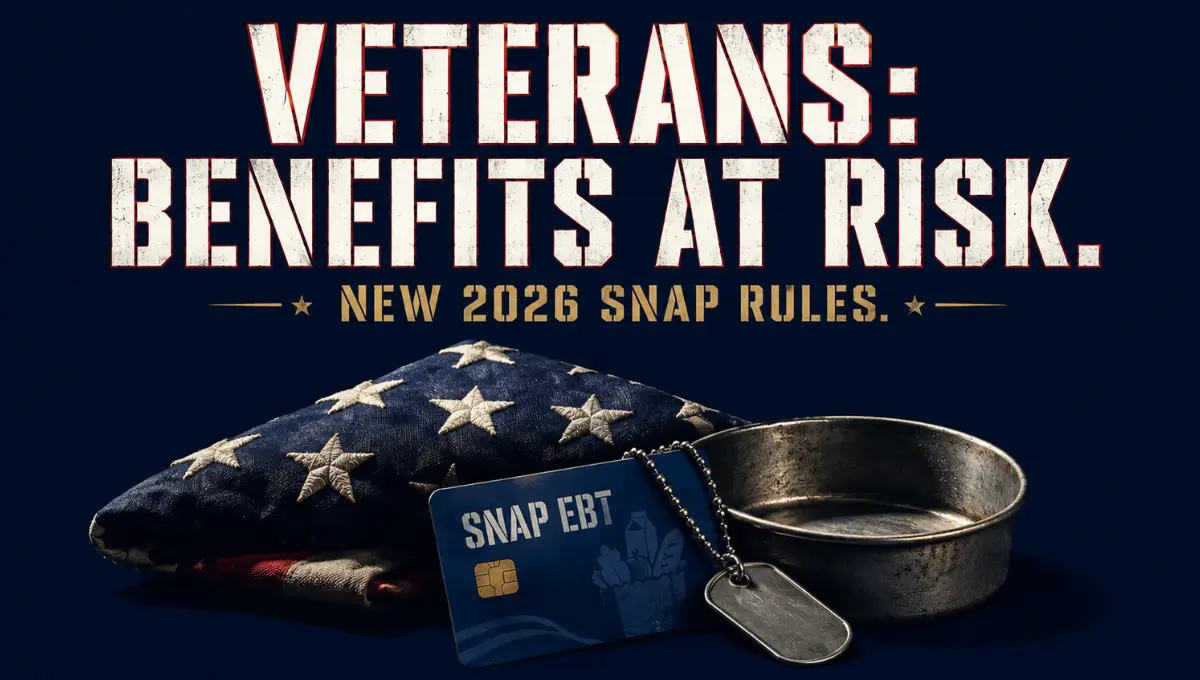
Veterans no longer get an automatic pass on SNAP work rules. A federal law called the One Big Beautiful Bill Act (H.R. 1), signed in July 2025, removed the blanket work exemption that veterans had relied on since late 2023. That change is now being enforced in nearly every state.
If you’re a veteran on SNAP, this means your VA status alone won’t protect your food benefits anymore.
You now need to either work, train, or volunteer 80 hours a month, or qualify for a different exemption, like a documented disability, pregnancy, or caring for a young child.
Most states began enforcing these new rules between February and March 2026.
If you haven’t heard from your caseworker yet, don’t wait.
This guide walks through exactly what changed, who’s still protected, and the steps to take right now to keep your benefits.
Page Contents
- 1 Article Summary
- 2 What Changed for Veterans on SNAP in 2026
- 3 New SNAP Work Requirements Explained
- 4 Are You Still Exempt? Check These Categories
- 5 How to Keep Your SNAP Benefits: Step-by-Step
- 6 State-by-State Differences: Why Your Timeline May Differ
- 7 Feed Our Veterans Act: Could This Change Again?
- 8 Frequently Asked Questions
- 9 What To Do Next
Article Summary
- The automatic SNAP work exemption for veterans ended under the 2025 federal law known as H.R. 1 (the One Big Beautiful Bill Act).
- SNAP work rules (called ABAWD rules) now apply to adults ages 18–64, up from the previous 18–54 range.
- To keep benefits past 3 months, you must complete 80 hours a month of paid work, volunteering, or an approved training program.
- A VA disability rating does not automatically exempt you. SNAP uses its own “unfit for work” standard, which usually needs a separate doctor’s statement.
- Most states rolled out the new rules between February 1 and March 1, 2026. Alaska is exempt until January 1, 2027.
- A bill called the Feed Our Veterans Act would restore the exemption, but as of mid-2026 it has not passed Congress.
What Changed for Veterans on SNAP in 2026
For years, veterans didn’t have to prove they were working to keep SNAP benefits. The Fiscal Responsibility Act of 2023 gave veterans, people experiencing homelessness, and former foster youth an automatic exemption from SNAP work time limits. That protection is gone.
Under the One Big Beautiful Bill Act, signed into law in July 2025, Congress eliminated that exemption entirely. The change didn’t take effect overnight.
The U.S. Department of Agriculture’s Food and Nutrition Administration (FNA, formerly called FNS) spent months writing implementation guidance, and states rolled out enforcement on their own timelines, mostly starting in early 2026.
Who This Affects
This change affects veterans ages 18 to 64 who receive SNAP, don’t have a qualifying disability on file with their SNAP office, and don’t have a dependent child young enough to qualify for the caregiver exemption. If that describes you, you’re now classified the same way as any other “able-bodied adult without dependents,” or ABAWD, under SNAP rules.
Why Some Confusion Exists Right Now
Here’s something worth knowing: as of this writing, the USDA’s own public work requirements page still lists veterans as exempt, and notes the agency is “in the process of providing guidance” on how the new law changes things. That’s because federal guidance and state-level rollout haven’t fully caught up with each other yet. Multiple states, news outlets, and legal aid groups confirm the exemption has already been removed in practice, even where federal web pages lag behind. When in doubt, your state SNAP office has the final word on your case.
New SNAP Work Requirements Explained
SNAP has two layers of work rules. General work requirements apply to most adults ages 16–59. A stricter layer, the ABAWD time limit, applies to adults without dependents and limits benefits to 3 months in 3 years unless you meet the work rule or an exemption.
Here’s how the ABAWD rule changed under the 2025 law:
| Rule | Before H.R. 1 | Starting 2026 |
|---|---|---|
| Age range covered | 18–54 | 18–64 |
| Veteran exemption | Automatic | Eliminated |
| Homeless exemption | Automatic | Eliminated |
| Former foster youth exemption | Automatic (through age 24) | Eliminated |
| Waiver unemployment threshold | Roughly 6–7% | Above 10% |
| Monthly work/activity requirement | 80 hours | 80 hours (unchanged) |
The 80-Hour Rule
To keep SNAP for more than 3 months in a 3-year period, you need 80 hours a month of one or a combination of these:
- Paid work
- Unpaid work exchanged for goods or services
- A SNAP Employment and Training (E&T) program
- Another approved federal, state, or local work program
- Assigned workfare hours
Simply looking for a job does not count toward the 80 hours. You need documented hours in one of the categories above.
Waivers Are Harder to Get
States can still ask the federal government to waive ABAWD rules in areas with high unemployment. But the bar moved. States used to qualify with unemployment rates around 6–7%. Now an area needs unemployment above 10%. That’s shrunk the number of counties where work rules are paused, so fewer veterans can rely on a local waiver to avoid the requirement.
Are You Still Exempt? Check These Categories
Losing the veteran-specific exemption doesn’t mean every veteran must work 80 hours a month. Several exemptions still apply to anyone, veteran or not, who meets the criteria.
You’re still excused from SNAP work rules if any of these apply to you:
| Exemption | What It Means |
|---|---|
| Medical or mental limitation | You’re certified as unable to work |
| Pregnancy | Applies at any stage of pregnancy |
| Age | Under 18, or 65 and older |
| Caregiver of a young child | A dependent child in your household (age threshold varies by state right now, so confirm with your caseworker) |
| Already working enough | 30+ hours a week, or earning at least 30 times the minimum wage weekly |
| Substance use treatment | Regularly attending an alcohol or drug treatment program |
| Student status | Enrolled at least half-time in school or a training program |
Medical and Disability Exemption
This is the most important exemption for many veterans. SNAP excuses you from work rules if you’re “unable to work due to a physical or mental limitation.” That’s a SNAP-specific standard, separate from your VA disability rating.
A 100% VA disability rating is often accepted as proof. But a partial rating, even a significant one, usually isn’t enough on its own. You’ll likely need a letter from a doctor, physician assistant, nurse practitioner, or licensed social worker stating you can’t work. Ask your SNAP office for their specific “fitness for work” or medical exemption form, and bring it to your next medical appointment.
Caregiver Exemption
If you live with a dependent child, you may still be excused from ABAWD rules. The exact age cutoff is in flux right now. Federal guidance published before the new law listed “under 18,” but multiple states and USDA’s newer implementation materials point to a narrower cutoff of children under 14. Because this detail is actively being finalized state by state, don’t assume either way. Call your local SNAP office and ask directly what age applies where you live.
How to Keep Your SNAP Benefits: Step-by-Step
- Contact your caseworker now. Don’t wait for a notice. Ask directly whether you’re classified as an ABAWD under the new rules.
- Check for a medical exemption first. If you have any condition, service-connected or not, that limits your ability to work, ask your SNAP office for their medical exemption form.
- Get your doctor’s statement. Have a doctor, social worker, or nurse practitioner document your limitation in writing and submit it before your certification period ends.
- Report dependents in your household. If you have a child living with you, tell your caseworker immediately. This is one of the strongest protections available.
- Ask about local waivers. Call 211 or your state SNAP office to check whether your county qualifies for a high-unemployment waiver.
- Enroll in SNAP E&T if you need hours. If you don’t qualify for an exemption, ask about your state’s SNAP Employment and Training program. It counts toward your 80 hours and can help you find steady work.
- Keep records. Save pay stubs, volunteer hour logs, or training program attendance sheets in case your state requests proof.
State-by-State Differences: Why Your Timeline May Differ
SNAP is a federal program, but states run the day-to-day administration. That means your exact deadlines, forms, and even how quickly the new veteran rule was enforced can differ depending on where you live.
For example, New York applied the new ABAWD rules statewide starting March 1, 2026, and its current three-year SNAP clock runs through September 30, 2026. Alaska negotiated an exemption from the new work requirements until January 1, 2027, due to its unique labor market and high veteran population. Many other states began enforcement around February 1, 2026. Because of this patchwork rollout, the safest move is always to confirm your specific deadline with your state SNAP agency rather than assuming a national date applies to you.
Feed Our Veterans Act: Could This Change Again?
Veterans’ groups and some lawmakers are pushing back. Representative Gabe Vasquez introduced the Feed Our Veterans Act in February 2026, aiming to restore the automatic SNAP work exemption for veterans. A separate bill, the Feed Hungry Veterans Act, would create a narrower permanent exemption for veterans with significant service-connected disability ratings or those receiving a VA pension.
As of mid-2026, neither bill has passed Congress or been signed into law. Don’t rely on either bill when planning your benefits. If you need SNAP now, apply for an exemption you currently qualify for, not one that may exist in the future.
Unrelated note: If you’ve seen headlines about veterans losing a “disability pension tax exemption” in 2026, that news refers to a policy change in India and has nothing to do with U.S. SNAP benefits.
Frequently Asked Questions
Do all veterans have to work now to get SNAP?
No. Veterans must meet the 80-hour monthly work rule only if they don’t qualify for another exemption, like a documented disability, pregnancy, or caring for a young dependent child.
Does my VA disability rating exempt me automatically?
Not always. A 100% rating is often accepted, but partial ratings usually require a separate doctor’s statement confirming you can’t work, since SNAP uses its own standard.
When did these new rules start?
Most states began enforcing the new ABAWD rules between February and March 2026, though exact dates vary by state. Alaska is exempt until January 1, 2027.
What happens if I don’t meet the work requirement?
You can receive SNAP for only 3 months within a 3-year period without meeting the 80-hour rule or an exemption. After that, benefits stop until you meet the requirement again.
Can I apply for SNAP if I’m not currently working?
Yes. You can apply regardless of employment status. Your caseworker will determine if you’re subject to work rules or qualify for an exemption.
Is the veteran exemption coming back?
Possibly, but not yet. The Feed Our Veterans Act would restore it, but as of mid-2026 it’s still a proposed bill and is not current law.
What To Do Next
If you’re a veteran on SNAP, don’t wait for a letter to arrive. Call your local SNAP office this week, ask where your case stands under the new rules, and start gathering any medical documentation you might need. A few minutes on the phone now could protect months of food assistance later.
Sources:
- U.S. Department of Agriculture, Food and Nutrition Administration — SNAP Work Requirements
- New York State Office of Temporary and Disability Assistance — SNAP Work Requirements
- U.S. Congress — H.R. 7383, Feed Our Veterans Act
Last updated: July 2026. SNAP rules vary by state and continue to change as agencies finalize guidance on the 2025 federal law. Confirm current details with your state SNAP office.
Related reading: See our guide on [SNAP Eligibility Requirements by State in 2026] for income limits and application steps in your state.