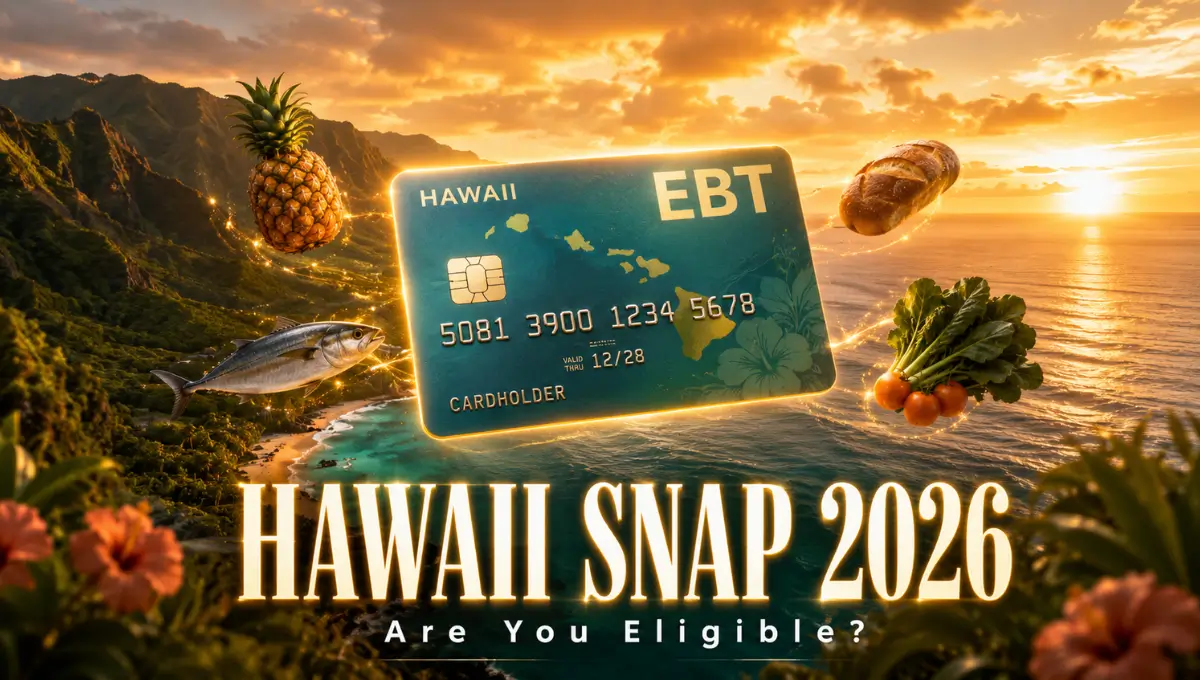
If you live in Hawaii and need food assistance, you may qualify for SNAP benefits in 2026. Most Hawaii households qualify under a special rule called Broad-Based Categorical Eligibility (BBCE).
This rule raises the income limit to 200% of the Federal Poverty Level — much higher than most mainland states.
This guide covers everything you need to know. Income limits, benefit amounts, deductions, work rules, and how to apply — all in one place.
Information is current as of June 15, 2026, and reflects the USDA FY 2026 standards effective October 1, 2025.
What Is Hawaii SNAP in 2026?
SNAP stands for Supplemental Nutrition Assistance Program. It is a federal program that helps low-income families buy food.
In Hawaii, the program is run by the Department of Human Services (DHS). Benefits are loaded onto an EBT card each month.
Hawaii has higher income limits than mainland U.S. states.
This is because the cost of living in Hawaii is much higher. Under BBCE rules, most households face no asset limit and qualify based only on gross monthly income.
📋 2026 Hawaii SNAP Quick Summary
- Most households qualify if gross monthly income is at or below 200% of the Federal Poverty Level
- No asset or savings limit for most households under BBCE rules
- Maximum monthly benefit for a single person is $538
- A family of 4 can receive up to $1,796 per month
- Income limits are effective October 1, 2025 through September 30, 2026
- “Sun Bucks” (Summer EBT) provides $189 per eligible child — apply by August 2, 2026
- Soft drinks/soda are no longer purchasable with SNAP in 2026 following new USDA approval
- Apply online at the PAIS Benefit Portal
2026 Hawaii SNAP Income Limits
Hawaii uses two income tests: gross income and net income. Under BBCE (which most households fall under), only the gross income limit applies — and it is set at 200% FPL.
For a full comparison of income limits across all states, see our guide to SNAP income limits by state in 2026.
Gross Income Limit (200% FPL — BBCE)
This is the limit that applies to most Hawaii households.
| Household Size | Monthly Gross Income Limit |
|---|---|
| 1 Person | $3,000 |
| 2 People | $4,054 |
| 3 People | $5,110 |
| 4 People | $6,164 |
| 5 People | $7,220 |
| 6 People | $8,274 |
| 7 People | $9,330 |
| 8 People | $10,384 |
| Each Additional Member | +$1,056 |
Gross income means your total household income before any taxes or deductions are taken out.
Net Income Limit (100% FPL)
The net income test applies only if your household includes an elderly (60+) or disabled member and your gross income is above the 200% FPL limit. Net income is what remains after allowed deductions are subtracted.
| Household Size | Monthly Net Income Limit |
|---|---|
| 1 Person | $1,500 |
| 2 People | $2,030 |
| 3 People | $2,560 |
| 4 People | $3,090 |
| 5 People | $3,620 |
| 6 People | $4,150 |
| 7 People | $4,680 |
| 8 People | $5,210 |
| Each Additional Member | +$530 |
Source: USDA SNAP FY 2026 Income Eligibility Standards
Standard Income Limits (130% FPL — Without BBCE)
If a household does not qualify under BBCE, the standard federal income limits below apply. These are much lower.
| Household Size | Monthly Gross Limit (130% FPL) |
|---|---|
| 1 Person | $1,949 |
| 2 People | $2,635 |
| 3 People | $3,321 |
| 4 People | $4,007 |
| 5 People | $4,692 |
| 6 People | $5,378 |
| 7 People | $6,064 |
| 8 People | $6,750 |
| Each Additional Member | +$686 |
Most applicants in Hawaii qualify under BBCE and do not need to worry about the 130% limits. If you are unsure which limits apply to you, use our SNAP eligibility calculator for 2026 to check your status.
Asset Limits for Hawaii SNAP 2026
Most households: No asset limit. Under BBCE, Hawaii does not count your savings, checking accounts, vehicles, or property.
Elderly or disabled households over the BBCE gross limit: If your income exceeds 200% FPL but you have an elderly or disabled member, you may still qualify. Your countable assets (cash and bank accounts) must be $4,500 or less.
2026 Hawaii SNAP Benefit Amounts
Your monthly benefit depends on your household size and net income. Larger households and lower incomes mean higher benefits.
Benefit Formula:Maximum Allotment − (30% × Net Income) = Monthly Benefit
Minimum Benefit: $41/month for 1–2 person households.
| Household Size | Maximum Monthly Benefit |
|---|---|
| 1 Person | $538 |
| 2 People | $987 |
| 3 People | $1,410 |
| 4 People | $1,796 |
| 5 People | $2,131 |
| 6 People | $2,557 |
| 7 People | $2,830 |
| 8 People | $3,230 |
Example: A family of 3 with $1,000 net monthly income would receive:
$1,410 − (30% × $1,000) = $1,410 − $300 = $1,110/month
Source: Hawaii DHS SNAP Program
Deductions That Can Increase Your Benefits
Deductions lower your net income, which raises your monthly benefit. Here are the deductions Hawaii SNAP allows in 2026.
Standard Deduction
Everyone gets this deduction automatically.
| Household Size | Standard Deduction |
|---|---|
| 1–4 People | $295/month |
| 5 People | $300/month |
| 6+ People | $344/month |
Shelter Deduction
You can deduct housing costs (rent, mortgage, utilities) that exceed 50% of your net income after other deductions. The cap is $1,003/month — but this cap is waived for households with an elderly or disabled member.
Medical Deduction (Elderly/Disabled Only)
If you or a household member is elderly (60+) or disabled, and out-of-pocket medical costs exceed $35/month, you can claim either:
- A standard medical deduction, or
- Your actual medical expenses
Basic Eligibility Requirements
To qualify for Hawaii SNAP in 2026, you must meet all of the following:
| Requirement | What You Need to Know |
|---|---|
| Hawaii Residency | You must currently live in Hawaii |
| Citizenship/Immigration Status | U.S. citizens or qualified non-citizens (Lawful Permanent Residents and COFA citizens from Micronesia, Marshall Islands, or Palau) |
| Social Security Number | All household members must provide an SSN or apply for one |
| Work Requirements | Most able-bodied adults must meet work requirements (see below) |
| Income | Must be at or below income limits listed above |
COFA Update (Effective November 1, 2025): Hawaii expanded SNAP eligibility to include individuals from Compact of Free Association (COFA) nations — Micronesia, Marshall Islands, and Palau. For details, see the Hawaii DHS COFA SNAP overview.
2026 Work Requirements for ABAWDs
ABAWD stands for Able-Bodied Adult Without Dependents. Work requirements apply to most adults who do not have children or disabilities.
Updated age range for 2026: Requirements now apply to adults aged 18 to 54 (expanded from the previous cap of 49). Some provisions phase this up toward age 64 — contact your DHS caseworker to confirm your specific situation.
What You Must Do (80 Hours Per Month)
- Work a paid job, OR
- Volunteer at a qualifying organization, OR
- Participate in a SNAP-approved job training or education program
Who Is Exempt
You do not have to meet work requirements if you:
- Are pregnant
- Are a veteran
- Are experiencing homelessness
- Are under 24 and recently aged out of foster care
- Have a physical or mental condition that limits your ability to work
For full work requirement details, see the Hawaii DHS SNAP Work Requirements FAQ.
What You Can and Cannot Buy With Hawaii SNAP in 2026
SNAP benefits can only be used to buy food for your household. Here is a quick breakdown:
| ✅ Eligible to Buy | ❌ Not Eligible |
|---|---|
| Fruits and vegetables | Alcoholic beverages |
| Bread and cereals | Tobacco products |
| Meat, poultry, and fish | Vitamins and medicines |
| Dairy products | Dietary supplements |
| Seeds and plants for food | Hot prepared foods (under normal rules) |
| Soft drinks/soda | ❌ NEW in 2026: Restricted |
🆕 2026 Soda Restriction
Hawaii received USDA approval to ban the purchase of soft drinks and soda with SNAP benefits starting in 2026. This makes Hawaii one of the first states to restrict soda under SNAP. Local health advocates supported the change to encourage healthier purchases, though some community groups have raised concerns about consumer choice.
Hot Food Waiver (Expired May 16, 2026)
A temporary Hot Food Waiver was active for storm-affected households, allowing the purchase of hot prepared meals. This waiver expired on May 16, 2026. If you were affected, check with your DHS office for any updates.
Sun Bucks: 2026 Summer EBT for Kids
Hawaii’s Sun Bucks program (Summer EBT) provides extra food assistance to school-aged children during summer months.
- Benefit amount: $189 per eligible child
- Who qualifies: Children enrolled in SNAP, Medicaid, or TANF households, or who qualify based on school income data
- When benefits loaded: Cards were loaded beginning May 27, 2026 for automatically enrolled families
- Application deadline: If your child was not automatically enrolled, you must apply by August 2, 2026
Contact your school or Hawaii DHS to check if your child is already enrolled.
How to Apply for Hawaii SNAP in 2026
Applying is free. You can apply in three ways:
- Online (Recommended): Visit the PAIS Benefit Portal at medical.mybenefits.hawaii.gov
- By Phone: Call 1-855-643-1643 to apply or ask questions
- By Mail or In Person: Download a paper application from the Hawaii DHS website, complete it, and mail or drop it off at your nearest DHS processing center
What to Have Ready
- Proof of Hawaii residency (utility bill, lease, etc.)
- Social Security Numbers for all household members
- Proof of income (pay stubs, benefit letters, etc.)
- Proof of identity (driver’s license, state ID, etc.)
- Immigration documents (if applicable)
After You Apply
- Your DHS caseworker will contact you to schedule an interview
- Most decisions are made within 30 days of application
- If approved, benefits are loaded onto your EBT card
Check Your SNAP Balance
To check your EBT balance or report a lost card:
- Call: 1-855-643-1643 (EBT Customer Service)
- Online: PAIS Benefit Portal
Federal vs. State SNAP Rules in Hawaii
It helps to know the difference between federal rules and what Hawaii does differently.
| Rule | Federal Default | Hawaii 2026 |
|---|---|---|
| Gross Income Limit | 130% FPL | 200% FPL (BBCE) |
| Asset Limit | $2,750 / $4,250 | None (most households) |
| Net Income Test | Required for all | Waived under BBCE |
| ABAWD Age Range | 18–49 | 18–54 (expanding) |
| Soda Purchase | Allowed | Restricted (new 2026) |
Frequently Asked Questions (FAQ)
1. What is the income limit for SNAP in Hawaii in 2026?
For most households, the gross monthly income limit is 200% of the Federal Poverty Level — $3,000 for one person and $6,164 for a family of four. This is higher than the federal default because Hawaii uses BBCE rules.
2. How much SNAP will I get in Hawaii in 2026?
The maximum monthly benefit is $538 for one person and $1,796 for a family of four. Your actual benefit depends on your household size and net income after deductions.
3. Do I need to have savings to qualify for Hawaii SNAP?
No. Under Hawaii’s BBCE rules, most households have no asset or savings limit. You are not required to spend down your bank account to qualify.
4. When does my EBT card get loaded in Hawaii?
Hawaii SNAP benefits are loaded onto EBT cards on a set schedule based on your case number. Contact DHS at 1-855-643-1643 or log in to the PAIS portal to check your deposit date.
5. Can I still buy soda with my Hawaii SNAP benefits?
No. As of 2026, Hawaii received USDA approval to restrict soft drink and soda purchases under SNAP. You can no longer use your EBT card to buy soda at participating retailers.
6. What are the work requirements for SNAP in Hawaii in 2026?
Able-bodied adults without dependents, ages 18–54, must work, volunteer, or participate in a job training program for at least 80 hours per month. Exemptions apply for veterans, pregnant individuals, homeless individuals, and those unable to work due to health reasons.
Related Articles
- SNAP Income Limits by State in 2026 — See how Hawaii compares to other states
- SNAP Eligibility Calculator for 2026 — Estimate your benefit amount before you apply
Official Sources
- Hawaii DHS SNAP Program
- USDA SNAP FY 2026 Income Eligibility Standards
- Hawaii DHS SNAP Work Requirements FAQ
- Hawaii DHS COFA SNAP Eligibility
Ready to Apply?
If you think you qualify, don’t wait. Apply today at medical.mybenefits.hawaii.gov or call 1-855-643-1643. If you’re unsure whether you qualify, use our SNAP eligibility calculator for 2026 to get a quick estimate before you apply. Benefits can start within 30 days — and every dollar helps put food on the table.
Last updated: June 15, 2026. This article reflects USDA FY 2026 income eligibility standards effective October 1, 2025 through September 30, 2026, and Hawaii DHS program rules current as of the date above. Program rules may change — always verify with the Hawaii DHS for the most current information.