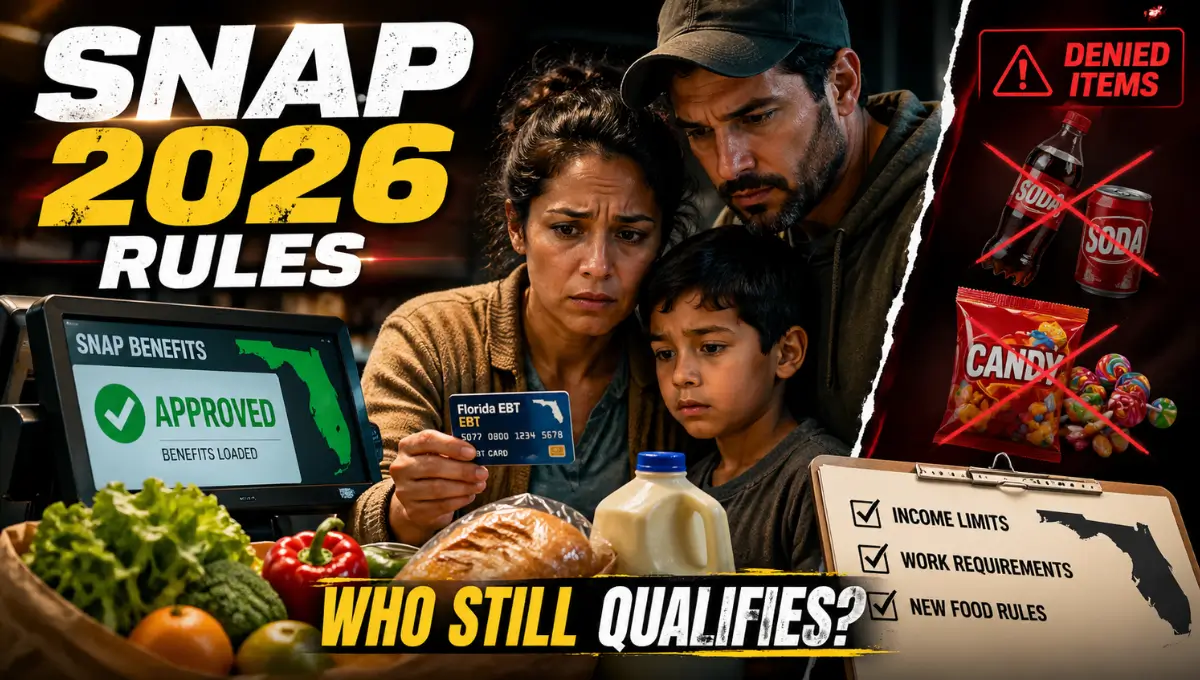
In 2026, Florida SNAP (food stamps) helps low-income residents buy groceries each month.
You may qualify if your household income is at or below 200% of the Federal Poverty Level (FPL).
New rules this year changed who qualifies, what you can buy, and work requirements.
📅 Last Updated: April 28, 2026 | Source: Florida DCF | USDA FNS
🔑 Quick Summary
- Program: SNAP (Supplemental Nutrition Assistance Program)
- Who runs it: Florida Department of Children and Families (DCF)
- Income limit: Up to 200% of the Federal Poverty Level (FPL)
- New in 2026: Work rules expanded; soda and candy now banned
- Benefits: Loaded monthly onto an EBT card
- Apply at: ACCESS Florida portal or your local DCF office
What Is Florida SNAP?
Florida SNAP gives monthly food benefits to low-income families. Benefits go directly onto an EBT (Electronic Benefits Transfer) card. You use it like a debit card at grocery stores.
About 2.59 million Floridians were enrolled in SNAP as of December 2025. That’s roughly 1 in 8 residents. New 2026 rules made the program smaller and stricter.
Florida SNAP Income Limits 2026
Florida uses a 200% FPL gross income limit. This is more generous than the federal standard of 130% FPL. Most families can qualify with higher incomes than in other states.
For a full state-by-state comparison, see our guide on SNAP income limits by state 2026.
Gross Income Limits (Monthly, Before Taxes)
| Household Size | Monthly Gross Income Limit |
|---|---|
| 1 person | $2,608 |
| 2 people | $3,526 |
| 3 people | $4,442 |
| 4 people | $5,358 |
| 5 people | $6,276 |
| 6 people | $7,192 |
| 7 people | $8,108 |
| Each extra person | +$916 |
Note: Elderly (60+) or disabled members who exceed the gross limit may still qualify. They must pass the net income and asset tests instead.
Net Income Limits (Monthly, After Deductions)
Net income is what’s left after deductions. It’s set at 100% FPL.
| Household Size | Monthly Net Income Limit |
|---|---|
| 1 person | $1,304 |
| 2 people | $1,763 |
| 3 people | $2,221 |
| 4 people | $2,679 |
| 5 people | $3,138 |
| 6 people | $3,596 |
| 7 people | $4,054 |
| Each extra person | +$458 |
Every $100 increase in net income reduces your benefit by about $30.
Not sure if you qualify? Use our free SNAP eligibility calculator 2026 to check in minutes.
Florida SNAP Benefit Amounts 2026
The more people in your home, the higher your benefit. These are the maximum amounts per month.
Maximum Monthly SNAP Benefits (FY 2026)
| Household Size | Max Monthly Benefit |
|---|---|
| 1 person | $298 |
| 2 people | $546 |
| 3 people | $785 |
| 4 people | $994 |
| 5 people | $1,183 |
| 6 people | $1,421 |
| 7 people | $1,571 |
| 8 people | $1,789 |
| Each extra person | +$218 |
- Minimum benefit: $24/month for 1–2 person households
- Average benefit in Jacksonville, FL: About $190 per person per month
Florida SNAP Deductions 2026
Deductions lower your gross income to get your net income. A lower net income means a higher benefit. Florida allows several deductions.
Standard and Earned Income Deductions
| Deduction Type | Amount |
|---|---|
| Standard deduction (1–3 people) | $209/month |
| Standard deduction (4 people) | $223/month |
| Standard deduction (5 people) | $261/month |
| Standard deduction (6+ people) | $299/month |
| Earned income deduction | 20% of gross wages |
Other Allowed Deductions
- Dependent care costs — child care for work or school
- Court-ordered child support paid by a household member
- Out-of-pocket medical expenses for members 60+ or disabled (amounts over $35/month)
- Shelter deduction — rent, mortgage, insurance, and utilities over 50% of income (max $744/month without elderly/disabled members; no cap for elderly/disabled households)
Utility Allowances (FY 2026)
| Allowance Type | Monthly Amount |
|---|---|
| Heating and Cooling | $430 |
| Basic Utility (2+ bills) | $348 |
| Phone Only | $56 |
| Homeless Shelter | $190 |
Florida SNAP Asset Limits 2026
Florida has waived the asset test for most households. Most applicants do not have a resource limit.
Exceptions
- Household with a disqualified member: $3,000 asset limit
- Household with elderly or disabled member (disqualified): $4,500 limit
- Your home and personal vehicles are NOT counted as assets
Basic SNAP Eligibility Requirements in Florida
Florida requires all applicants to meet several basic conditions. Failing even one may disqualify you.
These requirements apply to the entire household, not just the applicant.
Who Must Meet These Requirements
- ✅ Florida resident — Must live in Florida
- ✅ Identity proof — Driver’s license, passport, or other ID
- ✅ U.S. citizen or qualified noncitizen — See immigration section below
- ✅ Social Security Number — Or proof you applied for one
- ✅ Income below limit — 200% FPL gross, or pass net income test
- ✅ Work requirements — Most adults 18–64 must comply
- ✅ Child support cooperation — Must cooperate with enforcement if required
Who Cannot Receive SNAP
- ❌ Drug trafficking convictions
- ❌ Fleeing a felony warrant
- ❌ Repeated SNAP fraud violations
- ❌ Non-citizens without qualified immigration status
- ❌ Most college students enrolled at least half-time
SNAP Citizenship & Immigration Rules — 2026 Changes
Big changes came from the One Big Beautiful Bill Act (OBBBA), signed July 4, 2025. New immigration rules took effect February 1, 2026.
These changes affect many non-citizens in Florida. Read carefully if you or a family member is not a U.S. citizen.
Who Still Qualifies (Non-Citizens)
- Lawful Permanent Residents (green card holders) with 5+ years in the U.S.
- Cuban and Haitian Entrants (CHE)
- Citizens of COFA (Compact of Free Association) countries
- Children under 18
- LPRs who are blind, disabled, or have 40 qualifying work quarters
Who No Longer Qualifies (As of 2026)
- Refugees and asylees — no longer eligible
- Individuals with deportation withheld
- Hmong or Highland Laotian Tribal Members
- Iraqi and Afghan Special Immigrants (SIV holders)
- Certain Afghan nationals paroled between July 31, 2021 – September 30, 2023
- Certain Ukrainian nationals paroled between February 24, 2022 – September 30, 2024
Florida SNAP Work Requirements 2026
Work requirements are now stricter under the OBBBA. They took effect February 1, 2026. More adults must now meet work rules to keep their benefits.
There are two separate work requirement tracks in Florida.
Track 1 — SNAP Employment & Training (E&T)
- Applies to adults ages 18–59
- Must work, train, or volunteer at least 80 hours per month
- DCF refers participants to FloridaCommerce and CareerSource Centers
- Failing to comply can end benefits for you and your household
Track 2 — ABAWD Time Limits
- Applies to Able-Bodied Adults Without Dependents (ABAWDs)
- Age limit raised from 49 to 65 under the OBBBA
- May only receive SNAP for 3 months in any 3-year period without working
- Must work at least 20 hours per week to receive benefits beyond 3 months
Groups Now Required to Work (New in 2026)
These groups were previously exempt but now must meet work rules:
- Homeless individuals
- Veterans
- Former foster youth (age 24 or younger)
- Parents or caretakers of a child age 14 or older
Groups Still Exempt from Work Requirements
- Adults under 16 or age 65+
- SSI or SSDI recipients
- Medically certified as unable to work
- Students enrolled at least half-time
- Parents/caretakers of a child under age 6
- Caretakers of an incapacitated person
- Participants in drug/alcohol treatment
- Already working 30+ hours/week or earning $217.50+/week
⚠️ Watch: Florida HB 693 may raise the E&T work age to 64 and require photo IDs on EBT cards. As of April 2026, this bill is still under review.
New Food Restrictions — Effective April 20, 2026
This is the biggest Florida-specific change of 2026. The USDA approved Florida’s waiver on January 1, 2026. Restrictions took effect April 20, 2026.
Florida became the 10th state to ban certain food items from SNAP purchases. About 3 million Floridians are affected.
Items You Can NO LONGER Buy with Florida SNAP
- 🚫 Soda — including diet and zero-sugar versions
- 🚫 Energy drinks — any drink with more than 65 mg of caffeine
- 🚫 Candy — gummies, chocolate bars, hard candy
- 🚫 Packaged desserts — Oreos, Twinkies, packaged cookies
Items You CAN Still Buy with Florida SNAP
- ✅ Gatorade, Powerade, sparkling water, bottled coffees and teas
- ✅ Granola bars, Pop-Tarts, marshmallows, honey-roasted nuts
- ✅ Fresh bakery items and refrigerated desserts
- ✅ All baking ingredients — flour, sugar, mixes
- ✅ All fruits, vegetables, proteins, and grains
How it works: Retailers automatically block ineligible items at checkout. You don’t need to memorize every item — the register does it for you.
SNAP Recertification in Florida 2026
SNAP benefits do not last forever. You must renew (“recertify”) before your period ends.
Certification Period Lengths
| Household Type | How Long Benefits Last |
|---|---|
| Standard households | 6 months |
| ABAWDs | 4 months |
| Elderly/disabled with no income | 24 months (report at month 12) |
How to Recertify — Step by Step
- Watch for a DCF notice about 1 month before your period ends
- Complete the recertification application online or by mail
- Complete an interview — usually done by phone
- Submit documents — income, household size, and expenses
- Report changes within 10 days after the month the change happens
When must you report a change?
- Gross income rises above 130% FPL
- Work hours fall below 80 hours per month (for able-bodied adults)
How to Apply for Florida SNAP in 2026
Florida SNAP is managed by the Florida Department of Children and Families (DCF). You apply through the ACCESS Florida system.
You have three ways to apply. Choose whichever is easiest for you.
Application Methods
| Method | How |
|---|---|
| Online | ACCESS Florida Portal |
| In person | Visit your local county DCF office |
| By mail | Download an application from DCF website |
Documents You Need
- Proof of identity — birth certificate, passport, or permanent resident card
- Social Security Number — for all household members
- Proof of Florida residency — lease, utility bill, or similar
- Proof of income — pay stubs, employer letter, or benefit statements
- Citizenship or immigration documents — if applicable
After You Apply
- Most applicants complete a phone interview with a DCF worker
- Applications are processed within 30 days
- Expedited processing (7 days): for households with very low income and resources
- If denied: You have 90 days to request a Fair Hearing
Want to check if you qualify before applying? Try our SNAP eligibility calculator 2026 — it takes about 2 minutes.
2026 SNAP Program Changes: What You Need to Know
Several major changes are reshaping Florida SNAP this year. These affect costs, enrollment, and access.
Understanding these changes helps you plan ahead.
State Cost-Sharing
- States now pay up to 15% of benefit expenses based on error rates
- Federal admin reimbursement dropped from 50% to 25% — states now pay 75%
- Florida’s 15% error rate could cost the state about $1 billion per year
Enrollment Drop
- Florida lost 749,855 SNAP participants between December 2024 and December 2025
- That’s a 22.4% decline — due partly to stricter eligibility reviews
Pending Legislation: HB 693
- Would require a photo ID on EBT cards
- Would raise the work requirement age to 64
- As of April 2026, still under consideration — monitor updates from the Florida Legislature
Florida SNAP vs. Federal SNAP: Key Differences
| Feature | Federal Standard | Florida 2026 |
|---|---|---|
| Gross income limit | 130% FPL | 200% FPL |
| Asset limit | $2,750 (most households) | None (most households) |
| Food restrictions | None nationally | Soda & candy banned |
| ABAWD age limit | Up to age 49 | Up to age 65 |
| Work requirement age | Up to 49 (ABAWD) | Up to 65 (ABAWD) |
Florida is both more generous (higher income limits, no asset test) and more restrictive (food bans, expanded work rules) than the federal average.
For how Florida compares to other states, check our full breakdown: Florida SNAP Income Limits in 2026.
Official Sources & Resources
| Resource | Link |
|---|---|
| Florida DCF SNAP Eligibility | myflfamilies.com |
| USDA FNS SNAP Eligibility | fns.usda.gov |
| ACCESS Florida Application | dcf-access.dcf.state.fl.us |
| SNAP Income Limits by State 2026 | Internal Link — SNAP income limits by state 2026 |
| SNAP Eligibility Calculator | Internal Link — SNAP eligibility calculator 2026 |
| Florida SNAP Income Limits 2026 | Internal Link — Florida SNAP income limits in 2026 |
❓ Frequently Asked Questions (FAQ)
1. What are the income limits for Florida SNAP in 2026?
Florida uses 200% of the Federal Poverty Level (FPL) as the gross income limit. For a family of 4, that’s $5,358/month. Net income (after deductions) must be at or below 100% FPL — $2,679/month for a family of 4.
2. Can I still buy soda or candy with my Florida EBT card in 2026?
No. As of April 20, 2026, Florida bans soda, energy drinks, candy, and packaged desserts from SNAP purchases. Retailers automatically block these items at checkout. Other beverages like Gatorade and sparkling water are still allowed.
3. Do I have to work to get SNAP in Florida in 2026?
Most adults ages 18–59 must work, train, or volunteer at least 80 hours per month. ABAWDs up to age 65 face a 3-month time limit unless working 20+ hours weekly. Exemptions exist for parents of young children, disabled individuals, and students.
4. Are refugees or asylees eligible for Florida SNAP in 2026?
No. The One Big Beautiful Bill Act, signed July 4, 2025, removed SNAP eligibility for refugees and asylees. These changes took effect February 1, 2026. Green card holders with 5+ years of U.S. residency are still eligible.
5. How do I apply for Florida SNAP in 2026?
Apply online at the ACCESS Florida portal, in person at your local DCF office, or by mail. You’ll need proof of identity, income, residency, and Social Security numbers. Most applicants complete a phone interview. Processing takes up to 30 days, or 7 days for expedited cases.
6. How long does Florida SNAP last before I have to renew?
Most households have a 6-month certification period. ABAWDs recertify every 4 months. Elderly or disabled households with no income have a 24-month period, with a required report at month 12. DCF sends a renewal notice about one month before your period ends.
Sources: Florida Department of Children and Families (DCF) | USDA Food and Nutrition Service (FNS) | USDA FNS FY 2026 COLA | One Big Beautiful Bill Act (OBBBA), signed July 4, 2025
Last updated: April 28, 2026