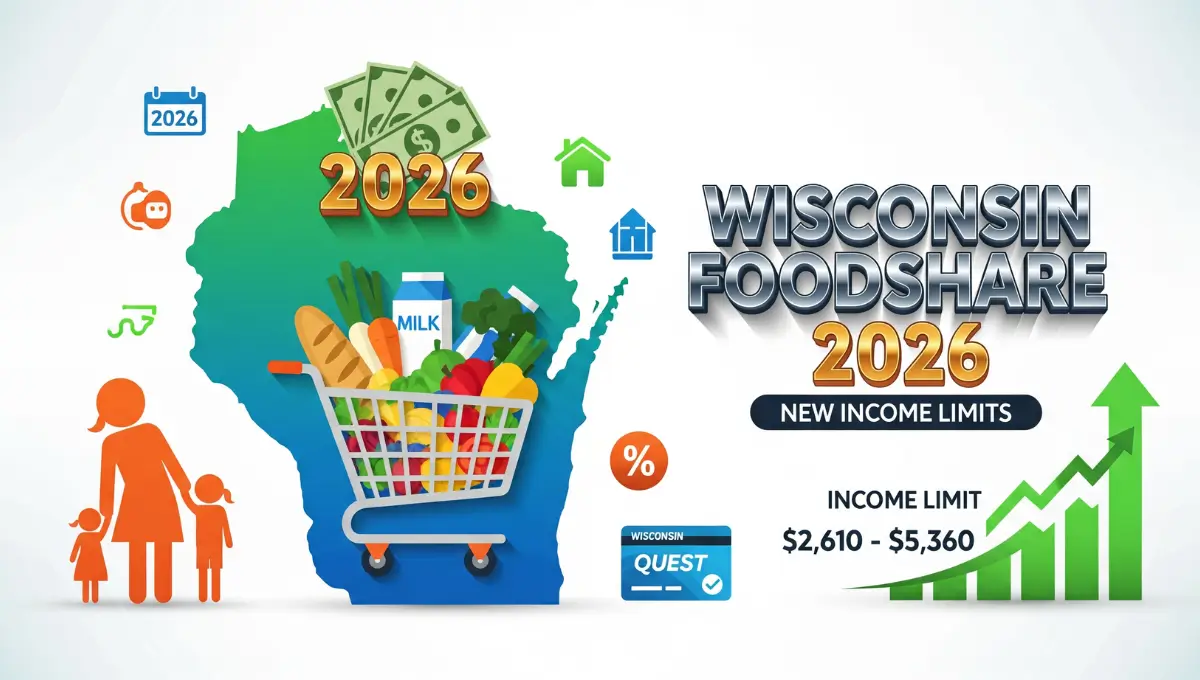
Wisconsin FoodShare helps low-income families buy groceries each month.
To qualify in 2026, a single person must earn $2,610 or less monthly, while a family of four can earn up to $5,360.
Wisconsin offers more generous income limits than most states because it uses 200% of the federal poverty level.
Quick Summary:
- Single person limit: $2,610/month gross income
- Family of 4 limit: $5,360/month gross income
- Maximum benefit for 1 person: $298/month
- Maximum benefit for family of 4: $994/month
- No asset limit for most households
- Apply online at access.wisconsin.gov
Page Contents
- 1 Who Can Get FoodShare in Wisconsin?
- 2 2026 Income Limits for Wisconsin FoodShare
- 3 Maximum FoodShare Benefit Amounts 2026
- 4 What Income Counts?
- 5 Deductions That Lower Your Countable Income
- 6 Asset and Resource Rules
- 7 Work Requirements for 2026
- 8 Special Rules for Seniors and Disabled
- 9 How to Apply for Wisconsin FoodShare
- 10 How Fast Can You Get Benefits?
- 11 Reporting Changes
- 12 Comparing Wisconsin to Other States
- 13 FAQs About Wisconsin FoodShare 2026
- 14 Contact Wisconsin FoodShare
- 15 Summary
Wisconsin FoodShare (also called SNAP) helps residents buy food.
You may qualify if you:
- Live in Wisconsin
- Earn below the income limits
- Are a U.S. citizen or qualified immigrant
- Meet work requirements (if age 18-64)
Wisconsin has no asset limit for most applicants. This makes it easier to qualify than in other states.
Gross Income Limits (Before Taxes)
Your household’s total monthly income must fall below these amounts:
| Household Size | Monthly Income Limit |
|---|---|
| 1 person | $2,610 |
| 2 people | $3,526 |
| 3 people | $4,442 |
| 4 people | $5,360 |
| 5 people | $6,276 |
| 6 people | $7,192 |
| 7 people | $8,110 |
| 8 people | $9,026 |
| Each extra person | Add $918 |
These limits are 200% of the federal poverty level. Wisconsin uses higher limits than federal SNAP rules.
Net Income Limits (After Deductions)
Net income is your income after allowed deductions. Some households must also meet net income limits:
| Household Size | Net Income Limit |
|---|---|
| 1 person | $1,305 |
| 2 people | $1,763 |
| 3 people | $2,221 |
| 4 people | $2,680 |
| 5 people | $3,138 |
| 6 people | $3,596 |
| Each extra person | Add $459 |
Who needs to meet net income limits?
Households with elderly (60+) or disabled members only if gross income exceeds $2,610 (for one person).
Your benefit amount depends on household size and net income:
| Household Size | Maximum Monthly Benefit |
|---|---|
| 1 person | $298 |
| 2 people | $546 |
| 3 people | $785 |
| 4 people | $994 |
| 5 people | $1,183 |
| 6 people | $1,421 |
| 7 people | $1,571 |
| 8 people | $1,789 |
Minimum benefit for 1-2 people: $24/month.
Most households get less than the maximum. Your exact amount depends on your income after deductions.
What Income Counts?
Earned Income
- Wages from jobs
- Self-employment profit
- Tips and bonuses
Unearned Income
- Social Security benefits
- SSI payments
- Unemployment benefits
- Child support received
- Pension or retirement income
- Veterans benefits
Income NOT Counted
- Free housing or meals from others
- Energy assistance payments
- One-time payments under $30
Calculate your monthly income carefully. Weekly pay × 4.3 = monthly income.
Deductions That Lower Your Countable Income
Wisconsin allows these deductions to calculate your benefit:
Standard Deduction (automatic):
- 1-3 people: $209
- 4 people: $223
- 5 people: $261
- 6+ people: $299
Earned Income Deduction: 20% of work income
Shelter Costs: Rent, mortgage, property tax, and utilities over 50% of income (up to $744 max)
Medical Expenses: For elderly/disabled, costs over $35/month
Child Care Costs: Actual costs for work-related care
Child Support Paid: Amount you pay monthly
Utility Allowances:
- Heat and cooling: $553
- Non-heat electric: $385
- Electric only: $155
- Phone: $31
These deductions can significantly increase your benefit amount.
Asset and Resource Rules
Most Households: No asset limit in Wisconsin.
Elderly or Disabled Households: $4,500 asset limit if income exceeds 200% poverty level.
Lottery winnings cannot exceed $4,500.
Wisconsin’s no-asset policy helps working families qualify more easily.
Work Requirements for 2026
Adults age 18-64 without children must work or volunteer 80 hours monthly.
Ways to Meet Requirements:
- Work at least 80 hours/month
- Participate in job training 80 hours/month
- Volunteer 80 hours/month
- Combine work and training
Who Is Exempt:
- Pregnant women
- Parents with children under 18
- Age 60 or older
- Disabled individuals
- Physically/mentally unable to work
Wisconsin offers free job training through the FoodShare Employment and Training (FSET) program.
Special Rules for Seniors and Disabled
If you’re 60+ or disabled, you get extra benefits:
- Can use medical expense deductions
- Higher asset limit ($4,500)
- No work requirements
- Can use benefits at senior meal sites
- Qualify based on net income only
Medical expenses over $35/month are fully deductible.
Application Methods
Online (Fastest): Visit access.wisconsin.gov to apply in 15-20 minutes.
By Phone: Call 1-888-794-5820 to apply over the phone.
In Person: Visit your local county FoodShare office.
Mobile App: Download MyACCESS app to manage benefits.
For detailed steps, see how to apply for SNAP in Wisconsin.
Documents You’ll Need
- Recent pay stubs (last 30 days)
- Social Security card
- Proof of address (lease, utility bill)
- ID for all household members
- Bank statements (if applicable)
You must complete a phone or in-person interview after applying.
How Fast Can You Get Benefits?
Standard Processing: 30 days from application date.
Expedited Service: If you qualify, benefits arrive in 7 days.
You get expedited service if:
- Monthly income is under $150 AND cash on hand is $100 or less
- Rent and utilities exceed income and cash combined
Benefits load onto your Wisconsin QUEST card monthly.
Reporting Changes
Report these changes within 10 days:
- Income increases over reporting limits
- Household size changes
- Address changes
- Job changes
Missing reports can stop your benefits.
Income reporting limits for 2026:
| Household Size | Report Income Over |
|---|---|
| 1 person | $1,696 |
| 2 people | $2,292 |
| 3 people | $2,888 |
| 4 people | $3,483 |
Comparing Wisconsin to Other States
Wisconsin’s 200% poverty level limit is more generous than most states. Many states use 130% limits.
To see how other states compare, check SNAP income limits by state.
Wisconsin also has no asset test for most households, unlike many states.
Yes. Many working families qualify for FoodShare. Your work income gets a 20% deduction, which increases your benefit amount. Use the Wisconsin SNAP calculator to estimate benefits.
Does my car count as an asset in Wisconsin?
No. Wisconsin has no asset limit for households meeting income requirements. Your car, savings, and home do not affect FoodShare eligibility for most applicants.
What if my income is slightly over the limit?
You may still qualify after deductions are applied. Shelter costs, medical expenses, and child care reduce your countable income. Apply to get an exact determination.
Yes, if you work 20+ hours weekly, care for a child, or participate in work-study programs. Full-time students have additional requirements but can qualify.
Your certification period is typically 6-12 months. You must recertify before benefits expire. Most households can recertify online without visiting an office.
No. FoodShare covers groceries only. You cannot buy prepared hot food, alcohol, tobacco, or non-food items. Seniors may use benefits at approved meal delivery services.
FoodShare Hotline: 1-800-362-3002
Online Application: access.wisconsin.gov
Official Website: dhs.wisconsin.gov/foodshare
Summary
Wisconsin FoodShare income limits for 2026 are generous compared to other states. Single individuals can earn up to $2,610 monthly, while families of four can earn $5,360. With no asset limit and multiple deductions available, more families can qualify.
Apply online today at access.wisconsin.gov or call 1-800-362-3002 for help.
Last Updated: January 13, 2026
Sources: