Last Updated: January 8, 2026
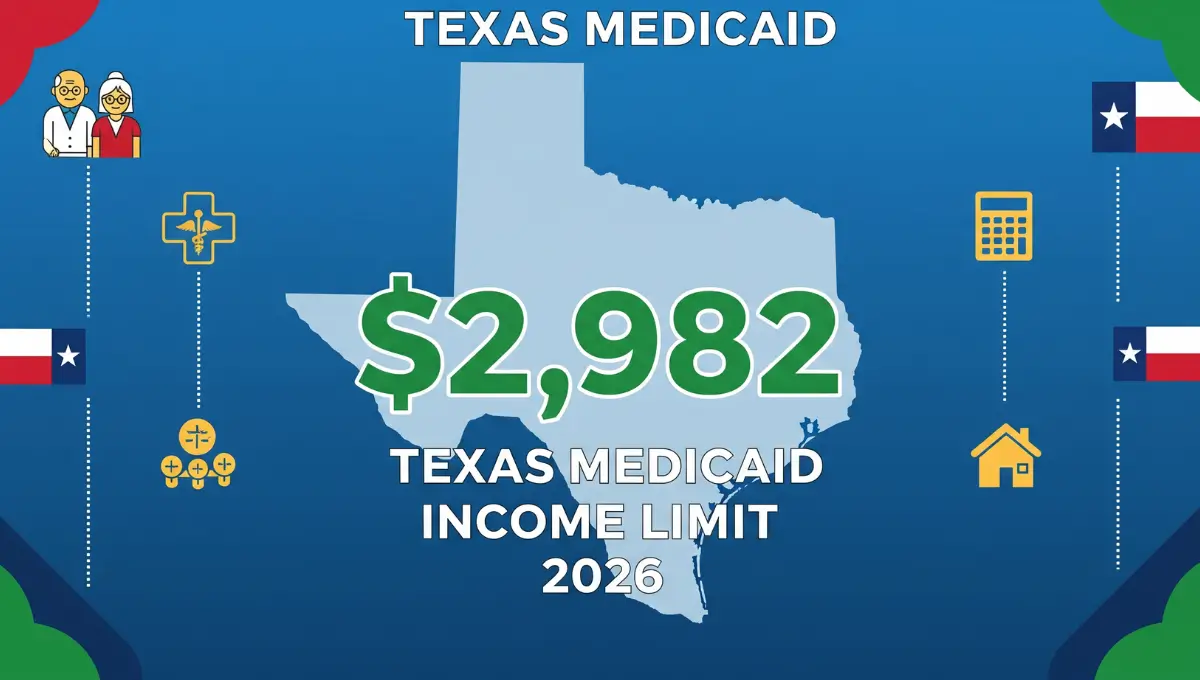
Do you qualify for Medicaid in Texas? In 2026, a single adult needing nursing home care can earn up to $2,982 per month, while children in families earning up to $2,647 monthly may qualify for free health coverage.
Quick Summary:
- Texas Medicaid covers seniors, children, pregnant women, disabled individuals, and nursing home residents
- Income limits range from $994 to $2,982 monthly depending on your category
- Asset limits are $2,000 for singles and $3,000 for married couples in most programs
- Texas has NOT expanded Medicaid—adults without disabilities or children rarely qualify
- You can apply online at Healthcare.gov or call 1-800-318-2596
- Average application processing takes 54 days as of January 2026
Page Contents
- 1 What Is Texas Medicaid?
- 2 Who Qualifies for Texas Medicaid in 2026?
- 3 Texas Medicaid Income Limits 2026
- 3.1 Nursing Home Medicaid Income Limits
- 3.2 What Income Counts?
- 3.3 Home and Community-Based Services (HCBS) Waiver Income Limits
- 3.4 Regular Medicaid for Aged, Blind, and Disabled (ABD)
- 3.5 Children’s Medicaid and CHIP Income Limits
- 3.6 Pregnant Women Medicaid Income Limits
- 3.7 Parents with Dependent Children Income Limits
- 4 Texas Medicaid Asset Limits 2026
- 5 How to Qualify with Higher Income: Miller Trust
- 6 Texas Medicaid Eligibility for Undocumented Immigrants
- 7 Does Texas Have Medicaid Expansion?
- 8 How to Apply for Texas Medicaid
- 9 Common Medicaid Planning Strategies
- 10 Recent Changes to Texas Medicaid in 2026
- 11 Texas Medicaid FAQs (2026)
- 11.1 1. What are 2026 income limits for nursing home Medicaid in Texas?
- 11.2 2. Can I qualify for Texas Medicaid waivers if over income limits?
- 11.3 3. What income qualifies my child for Texas Medicaid/CHIP in 2026?
- 11.4 4. Do pregnant women get 12-month postpartum coverage in Texas 2026?
- 11.5 5. What’s the income limit for parents with kids on Texas Medicaid?
- 11.6 6. Are non-disabled adults without kids eligible for Medicaid in Texas?
- 11.7 7. How long is Texas Medicaid application wait time in 2026?
- 11.8 8. How do federal H.R. 1 cuts affect Texas Medicaid 2026 eligibility?
- 12 Resources and Contact Information
- 13 Summary Table: Texas Medicaid Income Limits 2026
- 14 Final Thoughts
- 15 About the Author
What Is Texas Medicaid?
Medicaid is free or low-cost health insurance. It helps people who cannot afford medical care.
Texas Medicaid covers doctor visits, hospital stays, prescriptions, and more. The state runs the program with federal money.
Not everyone qualifies. You must meet income, asset, and category rules.
Who Qualifies for Texas Medicaid in 2026?
Texas Medicaid serves specific groups of people:
- Seniors age 65 and older
- Children under age 19
- Pregnant women
- People with disabilities
- Parents with very low income (around $230/month)
- Nursing home residents
Important: Texas did not expand Medicaid under the Affordable Care Act. Adults without disabilities or dependent children usually do not qualify, no matter how poor they are.
Over 1.1 million uninsured Texas adults would gain coverage if the state expanded Medicaid.
Texas Medicaid Income Limits 2026
Your income must fall below certain amounts. These amounts depend on which Medicaid program you need.
Nursing Home Medicaid Income Limits
Nursing home Medicaid helps pay for long-term care in a nursing facility.
Single Person:
- Monthly income limit: $2,982
- Asset limit: $2,000
Married Couple (Both Need Nursing Home Care):
- Combined monthly income limit: $5,964
- Combined asset limit: $3,000
Married Couple (Only One Needs Nursing Home Care):
- Applicant income limit: $2,982/month
- Applicant asset limit: $2,000
- Healthy spouse can keep up to $162,660 in assets
- Healthy spouse can keep up to $4,066.50/month in income
These limits come from federal standards that increase each year. The 2026 limits increased by 3% from 2025.
You can find more details about Medicaid income limits 2026 across all states on the official CMS website.
What Income Counts?
Almost all income counts toward the limit:
- Wages from work
- Social Security benefits
- Disability payments (SSDI)
- Pension payments
- IRA withdrawals
- Stock dividends
- Alimony
Income that does NOT count:
- VA Aid and Attendance benefits (above basic pension)
- Holocaust restitution payments
If your income is too high, you may still qualify using a Miller Trust. More on that below.
Home and Community-Based Services (HCBS) Waiver Income Limits
HCBS waivers help people get care at home instead of in nursing homes.
Income and asset limits are the same as nursing home Medicaid:
- Single person: $2,982/month income, $2,000 assets
- Married couple (both applying): $5,964/month income, $3,000 assets
Common Texas HCBS Waiver Programs:
- STAR+PLUS HCBS – For seniors and adults with disabilities
- HCS Waiver – For people with intellectual disabilities
- CLASS Waiver – For developmental disabilities
- MDCP – For medically dependent children ages 0-20
Important: These programs have waiting lists. You must get on an interest list and wait for an opening.
To join the interest list:
- STAR+PLUS: Call 1-800-964-2777
- Other waivers: Call 1-877-438-5658
Regular Medicaid for Aged, Blind, and Disabled (ABD)
This program helps seniors and disabled people who need medical care but not nursing home care.
Single Person:
- Monthly income limit: $994
- Asset limit: $2,000
Married Couple (Both Applying):
- Combined monthly income limit: $1,491
- Combined asset limit: $3,000
Who qualifies:
- People age 65 or older
- Blind individuals
- Disabled individuals (as defined by Social Security)
If you receive SSI benefits, you automatically qualify for Texas Medicaid.
Children’s Medicaid and CHIP Income Limits
Texas covers children through Medicaid and the Children’s Health Insurance Program (CHIP).
Income limits for children:
- Children under age 19: Up to 201-203% of federal poverty level
- Example: A family with one child may earn around $2,647/month
CHIP costs:
- Families earning 151% of poverty or less: No premium, $5 copay per visit
- Families earning 151-186% of poverty: $35/year premium, $20 copay
- Families earning 186-201% of poverty: $50/year premium, $25 copay
Application delays: As of January 2026, over 244,000 child applications are pending. Average wait time is 54 days.
About 400,000 eligible Texas children remain unenroloped. If your child needs coverage, apply today.
You can check CHIP eligibility details on the official Medicaid website.
Pregnant Women Medicaid Income Limits
Pregnant women can earn up to 198-203% of the federal poverty level and still qualify.
Coverage includes:
- Prenatal care
- Labor and delivery
- Postpartum checkups
12-Month Postpartum Coverage:
Texas now covers new mothers for 12 months after birth (previously only 60 days). This started in March 2024.
Postpartum coverage includes:
- Doctor checkups
- Mental health services
- Physical therapy
- Lactation support (new in 2026)
If you gave birth recently and lost Medicaid after 60 days, you may automatically get reinstated for the full 12 months.
Parents with Dependent Children Income Limits
Parents with children under 18 can qualify for Medicaid. But income limits are extremely low.
Income limit: About $230 per month for a single parent with two children
This equals about 15% of the federal poverty level. Very few working parents can qualify.
Texas Medicaid Asset Limits 2026
Assets are things you own. Medicaid counts most assets when deciding if you qualify.
What Assets Count?
Countable assets include:
- Cash
- Bank accounts
- Stocks and bonds
- Investments
- Cryptocurrency
- Second homes or rental property
- Extra vehicles (beyond the first one)
Assets that do NOT count:
- Your primary home (with equity limits explained below)
- One vehicle of any value
- Personal belongings and furniture
- Household items
- Irrevocable burial trusts
- IRAs or 401(k) accounts if you are taking required minimum distributions
Home Equity Limits
Your home usually does not count as an asset. But there are equity limits.
Home equity limit in 2026:
- Minimum: $752,000
- Maximum: $1,130,000 (in Texas and other high-cost states)
If you live in your home or your spouse lives there, it does not count. If your disabled child lives there, it does not count.
Asset Limits by Program
| Program | Single Person | Married Couple |
|---|---|---|
| Nursing Home Medicaid | $2,000 | $3,000 |
| HCBS Waivers | $2,000 | $3,000 |
| Regular Medicaid (ABD) | $2,000 | $3,000 |
Special rule for married couples: If only one spouse needs nursing home care, the healthy spouse can keep up to $162,660 in assets (or at minimum $32,532).
How to Qualify with Higher Income: Miller Trust
What if your income is too high? You may still qualify using a Miller Trust.
A Miller Trust is also called a Qualified Income Trust (QIT). It is a special bank account.
How it works:
You deposit your excess income into the trust each month. This reduces your countable income to the Medicaid limit.
Example:
You receive $3,500/month in Social Security. The nursing home limit is $2,982. You are $518 over the limit.
You put the extra $518 into a Miller Trust each month. Now your countable income is $2,982. You qualify for Medicaid.
The trust money can pay for your nursing home care or medical bills.
A lawyer can help you set up a Miller Trust. Learn more about Miller Trusts in Texas from elder law experts.
Texas Medicaid Eligibility for Undocumented Immigrants
Undocumented immigrants cannot get regular Medicaid in Texas. Federal law does not allow it.
Emergency Medicaid is available. This covers emergency medical care only.
Examples of emergency care:
- Heart attack treatment
- Stroke care
- Emergency surgery
- Labor and delivery for pregnant women
New federal rule in 2026: Starting October 1, 2026, the federal government will pay a smaller share of emergency Medicaid costs. This does not eliminate emergency coverage. But it may reduce state funding.
Hospital data collection: Since November 2024, Texas hospitals must ask patients about immigration status. But patients can refuse to answer. Refusing will not affect your emergency care.
Does Texas Have Medicaid Expansion?
No. Texas did not expand Medicaid under the Affordable Care Act.
What Is Medicaid Expansion?
Medicaid expansion would cover adults earning up to 138% of the federal poverty level. This includes adults without children or disabilities.
States with expansion: 40 states expanded Medicaid. Texas is one of 10 states that did not.
The Coverage Gap in Texas
Because Texas did not expand, many poor adults have no coverage option.
Who falls in the coverage gap:
- Adults without children
- Adults without disabilities
- Adults earning less than 100% of poverty (too poor for ACA subsidies)
About 920,000 uninsured Texas adults are in the coverage gap. They earn too much for Texas Medicaid but too little for marketplace subsidies.
Texas uninsured rate: 16.7% (highest in the nation).
Polls show 73% of Texans support Medicaid expansion. But the Texas Legislature rejected expansion in April 2025.
How to Apply for Texas Medicaid
You can apply for Medicaid in three ways:
1. Apply Online
Go to Healthcare.gov and fill out an application. You will need:
- Proof of income (pay stubs, Social Security statements)
- Proof of Texas residency
- Social Security numbers for household members
- Immigration documents (if applicable)
2. Apply by Phone
Call 1-800-318-2596 to apply over the phone. Assistance is available in multiple languages.
3. Apply Through Texas HHS
Visit the Texas Health and Human Services website at TexasHHS.org. You can also visit a local HHS office in person.
How Long Does It Take?
Average processing time: 54 days as of January 2026.
Federal law requires states to process applications within 45 days. Texas is currently missing this deadline.
Over 244,000 applications are pending. If your application is delayed, follow up by phone.
Common Medicaid Planning Strategies
Spend Down Assets
If you have too many assets, you can spend them down to qualify.
Allowed expenses:
- Pay off debt
- Make home repairs
- Buy a vehicle
- Prepay funeral expenses (irrevocable trust)
- Purchase medical equipment
Do not give away money or assets. This can trigger a penalty period.
Transfer Assets to Spouse
If you are married and one spouse needs nursing home care, you can transfer assets to the healthy spouse.
The healthy spouse can keep up to $162,660 without affecting Medicaid eligibility.
Use a Miller Trust for Income
As explained earlier, a Miller Trust lets you qualify even if your income exceeds the limit.
Get Help from an Elder Law Attorney
Medicaid planning is complex. An experienced elder law attorney can help you:
- Protect your home
- Set up trusts
- Spend down assets legally
- Avoid penalty periods
Recent Changes to Texas Medicaid in 2026
12-Month Postpartum Coverage (Effective March 2024)
New mothers now get Medicaid for 12 months after giving birth. This is up from 60 days.
Many women are unaware of this change. If you lost coverage after 60 days, you may be eligible for reinstatement.
Lactation Support Benefit (New in 2026)
Texas Medicaid now covers lactation consulting services. About 54,861 women per month are expected to use this benefit.
Federal Medicaid Funding Cuts
In July 2025, Congress passed H.R. 1 (the “One Big Beautiful Bill Act”). This law cuts Medicaid funding by $1 trillion over 10 years.
Changes include:
- Eligibility checks every 6 months (instead of once a year)
- Shorter retroactive coverage periods
- Work requirements in some states
- Stricter immigrant eligibility rules
Experts estimate 17 million Americans will lose Medicaid coverage nationwide. Texas will see reduced federal funding, which may lead to benefit cuts or stricter eligibility rules.
Application Processing Delays
Texas continues to struggle with application backlogs. Wait times reached 83 days in summer 2025. Improvements are ongoing but delays remain.
Texas Medicaid FAQs (2026)
1. What are 2026 income limits for nursing home Medicaid in Texas?
2. Can I qualify for Texas Medicaid waivers if over income limits?
3. What income qualifies my child for Texas Medicaid/CHIP in 2026?
4. Do pregnant women get 12-month postpartum coverage in Texas 2026?
5. What’s the income limit for parents with kids on Texas Medicaid?
6. Are non-disabled adults without kids eligible for Medicaid in Texas?
7. How long is Texas Medicaid application wait time in 2026?
8. How do federal H.R. 1 cuts affect Texas Medicaid 2026 eligibility?
Resources and Contact Information
Apply for Medicaid
- Website: Healthcare.gov
- Phone: 1-800-318-2596
- Texas HHS: TexasHHS.org
HCBS Waiver Interest Lists
- STAR+PLUS HCBS: 1-800-964-2777
- Other waivers: 1-877-438-5658
Official Government Resources
- Centers for Medicare & Medicaid Services: Medicaid.gov
- Texas Health and Human Services: HHS.Texas.gov
Summary Table: Texas Medicaid Income Limits 2026
| Program | Single Person | Married Couple |
|---|---|---|
| Nursing Home Medicaid | $2,982/month | $5,964/month (both applying) |
| HCBS Waivers | $2,982/month | $5,964/month (both applying) |
| Regular Medicaid (ABD) | $994/month | $1,491/month |
| Children (Medicaid/CHIP) | Up to 203% FPL | Family income assessed |
| Pregnant Women | Up to 203% FPL | Family income assessed |
| Parents with Children | ~$230/month | Very limited |
Final Thoughts
Texas Medicaid helps millions of people get health care. But eligibility rules are strict. Understanding income limits, asset rules, and program categories is the first step.
If you think you qualify, apply today. Processing takes time, so start as soon as possible.
If you need help with nursing home costs or have high income, talk to an elder law attorney about Medicaid planning.
About the Author
My name is Akash Biswas. I like to read hard government rules and make them easy to understand. Many people find Medicaid and Medicare confusing, and that is okay. I want to help.
I made this website so families can learn in simple words. I take big, hard information and break it into small, easy steps. I want every person to feel calm and sure when they read about Medicaid or Medicare.
My goal is to help you understand who can get help, how to apply, and what to do next. I hope this website makes your life easier and helps you get the care you need.
I study Medicaid and Medicare rules every day and work hard to share clear, correct, and easy information for all families.