Last Updated: April 1, 2026 | Sources: USDA Food and Nutrition Service (FNS), U.S. Congress
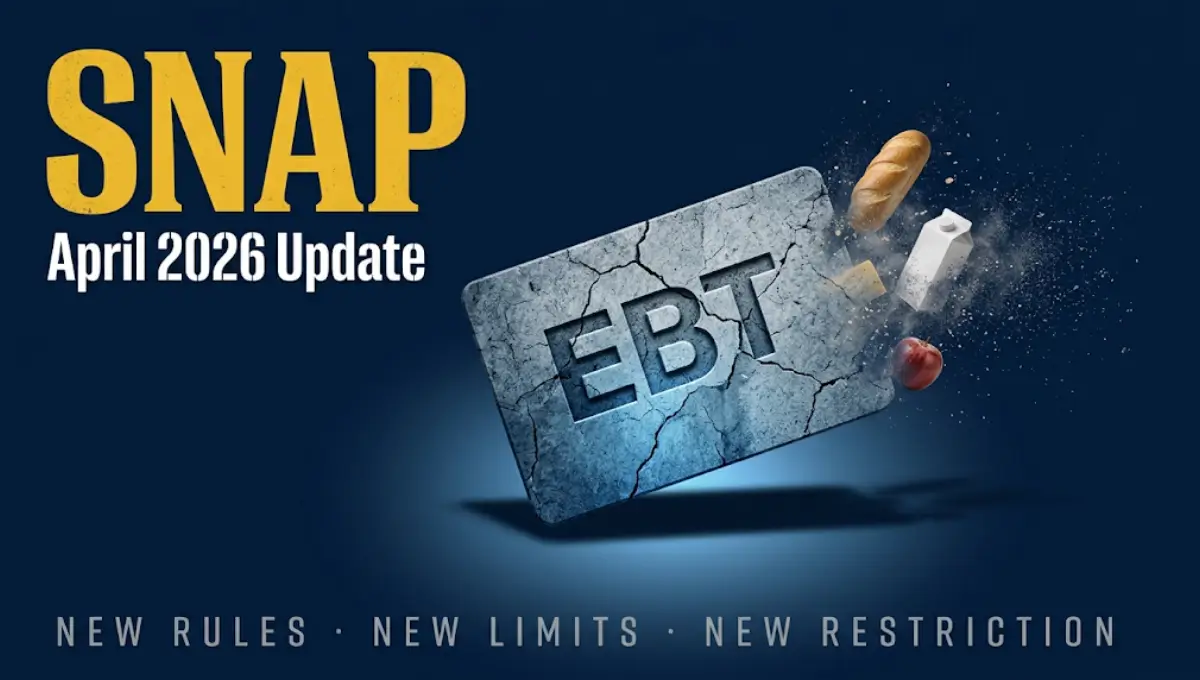
April 2026 brings the biggest changes to SNAP in decades. New food rules, stricter work requirements, and lower benefits for some groups are now in effect.
This article explains every change clearly so you know exactly what to expect.
Here’s what you need to know right now:
- SNAP maximum benefit for a family of 4 is $994/month in April 2026
- Texas, Virginia, Florida, and West Virginia now ban soda, candy, and sweetened drinks
- Work requirements now apply to adults up to age 64 — up from 54
- Refugees and asylees lose SNAP access on April 9, 2026 in 21 states
- EBT deposits begin April 1 in most states — dates vary by case number
- A single person must earn under $1,696/month gross to qualify
Page Contents
- 1 What Is Changing With SNAP in April 2026?
- 2 April 2026 SNAP Benefit Amounts (Maximum Allotments)
- 3 SNAP Income Limits for April 2026
- 4 New SNAP Food Restrictions: What You Can No Longer Buy
- 5 SNAP Work Requirements: What Changed in April 2026
- 6 Noncitizen SNAP Eligibility: April 9, 2026 Deadline
- 7 SNAP EBT Payment Schedule: April 2026 by State
- 8 The 2026 Farm Bill: What It Means for SNAP
- 9 State Cost-Sharing: New Financial Rules Starting FY 2027
- 10 How SNAP Connects to Medicaid and Other Benefits
- 11 State Legislative Responses to April 2026 SNAP Changes
- 12 How to Apply for SNAP in April 2026
- 13 Frequently Asked Questions (FAQs)
- 13.1 What are the new SNAP changes for April 2026?
- 13.2 What food items can you no longer buy with SNAP in 2026?
- 13.3 How much SNAP will a family of 4 get in April 2026?
- 13.4 Who is losing SNAP benefits in April 2026?
- 13.5 What are the SNAP income limits for 2026?
- 13.6 Does the new SNAP work requirement apply to people over 55?
- 13.7 When will SNAP benefits be deposited in April 2026?
- 13.8 Will SNAP benefits be cut in 2026 because of the new law?
- 13.9 What happens to SNAP if states have high payment error rates?
- 13.10 Can noncitizens still get SNAP after April 2026?
- 14 Sources and Official References
What Is Changing With SNAP in April 2026?
April 2026 is one of the most significant months in SNAP history. Several major policy changes are happening at the same time, affecting millions of Americans.
The One Big Beautiful Bill Act (OBBBA), signed on July 4, 2025, cut $187 billion from SNAP over 10 years. These cuts are now becoming real for households, states, and retailers across the country.
Here is a quick overview of the biggest April 2026 changes:
| Change | Effective Date |
|---|---|
| Texas & Virginia food restrictions begin | April 1, 2026 |
| West Virginia retailer compliance deadline | April 1, 2026 |
| Arkansas mandatory work program launches | April 1, 2026 |
| Noncitizen eligibility cuts take effect | April 9, 2026 |
| Florida food restrictions begin | April 20, 2026 |
| D.C. work requirement screening form released | April 27, 2026 |
April 2026 SNAP Benefit Amounts (Maximum Allotments)
The April 2026 SNAP benefits are based on the FY 2026 Cost-of-Living Adjustment (COLA), effective since October 1, 2025.
These are the maximum amounts a household can receive if they have zero net income.
Maximum Monthly SNAP Benefits for the 48 States and D.C.
| Household Size | 48 States & D.C. | Alaska (Urban) | Alaska (Rural 1) | Alaska (Rural 2) | Guam | Hawaii | Virgin Islands |
|---|---|---|---|---|---|---|---|
| 1 person | $298 | $385 | $491 | $598 | $439 | $506 | $383 |
| 2 people | $546 | $707 | $901 | $1,097 | $806 | $929 | $703 |
| 3 people | $785 | $1,015 | $1,295 | $1,576 | $1,157 | $1,334 | $1,009 |
| 4 people | $994 | $1,285 | $1,645 | $2,002 | $1,465 | $1,689 | $1,278 |
| 5 people | $1,183 | $1,526 | $1,954 | $2,378 | $1,740 | $2,006 | $1,518 |
| 6 people | $1,421 | $1,832 | $2,345 | $2,854 | $2,088 | $2,408 | $1,822 |
| 7 people | $1,571 | $2,025 | $2,592 | $3,154 | $2,308 | $2,661 | $2,014 |
| 8 people | $1,789 | $2,306 | $2,951 | $3,591 | $2,628 | $3,030 | $2,294 |
| Each extra person | +$224 | +$288 | +$369 | +$449 | +$329 | +$379 | +$287 |
Note: The minimum benefit for the 48 contiguous states and D.C. is $24 per month for FY 2026.
How Is Your SNAP Benefit Calculated?
Your actual benefit is almost never the maximum. It depends on your net income after deductions.
The formula is:
Monthly Benefit = Maximum Allotment − (30% × Net Monthly Income)
Example: A family of 3 with $500 net income receives:
- $785 − (0.30 × $500) = $785 − $150 = $635/month
Key Deductions for FY 2026
These deductions lower your net income and raise your benefit:
- Standard deduction (1–3 person household): $209/month
- Maximum excess shelter deduction: $744/month
- Homeless shelter deduction: $198.99/month
SNAP Income Limits for April 2026
To get SNAP, your household must pass two income tests — gross income and net income.
To see how these limits break down in every state, visit our full guide on SNAP income limits by state in 2026.
2026 SNAP Income Eligibility Table
| Household Size | Gross Monthly Income (130% FPL) | Net Monthly Income (100% FPL) | Elderly/Disabled (165% FPL) |
|---|---|---|---|
| 1 | $1,696 | $1,305 | $2,152 |
| 2 | $2,292 | $1,763 | $2,907 |
| 3 | $2,888 | $2,221 | $3,663 |
| 4 | $3,483 | $2,680 | $4,418 |
| 5 | $4,079 | $3,138 | $5,174 |
| 6 | $4,675 | $3,596 | $5,930 |
| 7 | $5,271 | $4,055 | $6,685 |
| 8 | $5,867 | $4,513 | $7,441 |
| Each extra person | +$596 | +$459 | +$756 |
Who Is Exempt From the Income Test?
Some households do not need to pass the gross income test:
- Households where all members receive SSI or TANF are often categorically eligible.
- Elderly or disabled households only need to meet the 165% FPL net income limit.
- Households in states with broad-based categorical eligibility may have higher limits.
✅ Tip: If your income is just over the limit, deductions for shelter, childcare, and medical costs may still qualify you. Always apply and let your state agency decide.
New SNAP Food Restrictions: What You Can No Longer Buy
One of the most talked-about April 2026 SNAP changes is the expansion of food restriction waivers.
Under the administration’s “Make America Healthy Again” agenda, the USDA has approved demonstration projects in 18 states that ban the purchase of certain food items using SNAP benefits.
These waivers are a major shift. For 60 years, SNAP had a single national list of eligible foods. Now, that list is different depending on which state you shop in.
Texas SNAP Food Restrictions (Effective April 1, 2026)
Texas became one of the first major states to restrict SNAP food purchases. The rules apply statewide to all Lone Star Card transactions.
Restricted in Texas:
| Category | What Is Banned |
|---|---|
| Candy | Candy bars, gum, taffy, candied/glazed nuts, candied raisins or fruits |
| Sweetened Drinks | Any beverage with 5g or more of added sugar per serving, or any amount of artificial sweetener |
Still allowed in Texas:
- Milk
- 100% fruit juice
- Unsweetened carbonated water
Texas is required to survey SNAP recipients before and after the April 1 rollout to measure changes in dietary habits.
Virginia SNAP Food Restrictions (Effective April 1, 2026)
Virginia launched its statewide waiver on the same day as Texas. The restriction focuses on carbonated soft drinks only.
Virginia’s key rule: Non-carbonated beverages — including iced tea, lemonade, and juice — are not restricted, even if they contain added sugar. Only carbonated sweet drinks are banned.
Florida SNAP Food Restrictions (Effective April 20, 2026)
Florida’s “Healthy SNAP” restrictions go further than Texas or Virginia. The Florida Department of Children and Families received approval to ban a broader range of products.
Restricted in Florida starting April 20:
- 🥤 Soda: All standard carbonated soft drinks
- ⚡ Energy drinks: Beverages with added caffeine or stimulants
- 🍬 Candy: Chocolate bars, gummies, hard candies, and caramels
- 🍩 Ultra-Processed Desserts: Packaged donuts, pastries, cookies, and snack cakes
West Virginia SNAP Restrictions (Full Compliance April 1, 2026)
West Virginia’s soda ban started January 1, 2026, but retailers had a 90-day grace period. That grace period ends April 1, 2026.
What West Virginia bans:
Any carbonated, non-alcoholic beverage with all four of these:
- Water
- A sweetening agent
- Flavoring
- Added carbonation
If a drink is missing even one of these (e.g., it’s non-carbonated), it is still allowed.
⚠️ Retailer Warning: Stores in West Virginia that do not comply after April 1 face a formal warning on the first violation and removal from the SNAP program on the second.
What If You Travel to Another State?
This is a common question in April 2026. Here is what you need to know:
- If you live in Texas and shop in a state with no restrictions, you can buy restricted items there.
- If you live in a non-restricted state and shop in Texas, you must follow Texas rules at checkout.
- Online retailers must also follow the rules based on your delivery address.
SNAP Work Requirements: What Changed in April 2026
The OBBBA expanded work requirements for Able-Bodied Adults Without Dependents (ABAWDs). These changes are rolling out state by state in April 2026 and are among the most impactful changes for working-age adults.
New ABAWD Age Limit
Under the old rules, work requirements applied to adults ages 18 to 54. Starting in 2025 under the OBBBA, that upper age limit was raised to 64.
This means adults between 55 and 64 are now required to work or participate in job training to keep their SNAP benefits.
How Many Hours Must You Work?
An ABAWD must meet at least one of these every month:
- ✅ Work at least 80 hours per month
- ✅ Participate in a qualifying work or training program for 80 hours/month
- ✅ Do a combination of work and training totaling 80 hours/month
If these requirements are not met, the person can only receive 3 months of SNAP in a 36-month period.
Who Lost Their Work Requirement Exemption?
The OBBBA removed exemptions for several groups who were previously protected:
| Group | Old Status | April 2026 Status |
|---|---|---|
| Veterans | Exempt | Now subject to work requirements (unless disabled) |
| Homeless individuals | Exempt | Now subject to work requirements |
| Former foster youth (under 25) | Exempt | Now subject to work requirements |
| Native Americans (Indian Health Services) | Varied | New specific exception added |
Child Age Change for Parent Exemptions
Previously, a parent with a child under 18 was exempt from ABAWD rules. The OBBBA lowered that age to 14.
This means parents whose youngest child is 14 or older may now face work requirements.
April 2026 Work Requirement Updates by State
Several states have specific milestones happening this month:
Arkansas (April 1, 2026): Arkansas launched its Mandatory SNAP Employment and Training (E&T) program. This program was previously voluntary. Now, ABAWDs, adults with school-aged children, and other non-exempt individuals must participate in SNAP Works. Arkansas expects to serve approximately 91,948 work registrants.
New York City (April 2026): March 2026 was the first month counting toward the 3-month time limit for newly required individuals ages 55–64. April is month two. If individuals do not report work hours for March, April, and May, they will lose benefits in June 2026.
District of Columbia (April 27, 2026): D.C. will release its SNAP Work Requirement Screening Form on April 27, 2026, online and via its mobile app. Work requirement enforcement officially begins May 1, 2026. D.C. is already sending notices to all affected households throughout April.
California (Partial Waiver): California obtained work requirement waivers for high-unemployment counties — including Imperial, Merced, and Tulare — through October 31, 2026.
Noncitizen SNAP Eligibility: April 9, 2026 Deadline
One of the most urgent SNAP changes in April 2026 affects refugees, asylees, and other humanitarian immigrants. This change has a hard deadline of April 9, 2026.
Background: The Injunction Expires
The OBBBA (Section 10108) removed SNAP access for refugees, asylees, and trafficking victims during their first five years in the U.S. A coalition of 21 states and D.C. sued the USDA, arguing the rule was arbitrary.
On December 15, 2025, a federal judge granted a preliminary injunction protecting these groups. That injunction expires on April 9, 2026.
What Happens After April 9?
After April 9, 2026, noncitizens who previously had access under the humanitarian exemption will lose SNAP eligibility unless they qualify under the new, narrower rules.
Groups still eligible for SNAP after April 9:
- ✅ U.S. Nationals
- ✅ Lawful Permanent Residents (Green Card holders) with 5+ years in the U.S.
- ✅ LPRs who are children, disabled, or have a military connection (no 5-year wait)
- ✅ Cuban and Haitian Entrants
- ✅ Individuals under Compacts of Free Association (COFA)
Groups losing eligibility after April 9:
- ❌ Refugees who have not yet obtained LPR (Green Card) status
- ❌ Asylees without LPR status
- ❌ Victims of trafficking in their first 5 years
In California alone, approximately 72,000 individuals are estimated to lose coverage due to this change.
In states not part of the lawsuit (such as Arizona and Nebraska), these cuts were already enforced starting October 2025.
SNAP EBT Payment Schedule: April 2026 by State
SNAP benefits are loaded on EBT cards on a staggered schedule. This spreads out grocery store demand across the month. Benefits are typically available by 8:00 AM on your payment date.
April 2026 SNAP EBT Deposit Dates
| State | Payment Dates | Basis |
|---|---|---|
| Alabama | April 4 – 23 | Two-digit case number |
| Arizona | April 1 – 13 | First letter of last name |
| Arkansas | April 4 – 13 | Last digit of Social Security Number |
| California | April 1 – 10 | Last digit of case number |
| Colorado | April 1 – 10 | Last digit of SSN |
| Florida | April 1 – 28 | Case number |
| Georgia | April 5 – 23 | Client Identification Number |
| Illinois | April 1 – 20 | State distribution schedule |
| Indiana | April 5 – 23 | First letter of last name |
| Maryland | April 4 – 23 | First three letters of last name |
| New York | April 1 – 9 | Varies (NYC vs. Rest of State) |
| Texas | April 1 – 28 | Eligibility Determination Group number |
| Virginia | April 1 – 7 | State schedule |
| Washington | April 1 – 20 | State distribution system |
States that deposit ALL benefits on April 1: Alaska, North Dakota, Rhode Island, Vermont, and the Virgin Islands.
💡 Tip: Funds typically transfer at midnight and are available by 8:00 AM. Check your EBT balance at www.benefits.gov or your state’s EBT portal.
The 2026 Farm Bill: What It Means for SNAP
The Farm, Food, and National Security Act of 2026 is moving through Congress in April 2026. On March 5, 2026, the House Agriculture Committee passed the bill 34–17 after a 20-hour session.
The bill is the first major agricultural reauthorization since 2018, following years of extensions. Here is what it means for SNAP specifically:
Key SNAP Provisions in the 2026 Farm Bill
- Cost-neutral Thrifty Food Plan: Future benefit re-evaluations cannot increase federal spending. This effectively caps long-term benefit growth.
- Privatization of eligibility: States could outsource SNAP eligibility determinations to private companies.
- Hot food parity: A provision would allow SNAP to be used for hot prepared foods at authorized retailers — a major policy shift.
The bill’s Senate version and final floor negotiations in April 2026 will determine if any of the OBBBA’s $187 billion in cuts are reversed or softened.
State Cost-Sharing: New Financial Rules Starting FY 2027
A major structural change coming out of the OBBBA will reshape how states pay for SNAP. While these rules begin in FY 2027 (October 2026), states are being assessed on their error rates right now in April 2026.
What Is the Payment Error Rate?
The payment error rate is the average of overpayments and underpayments made to SNAP households. Starting in FY 2028, states must pay a share of benefit costs based on this rate.
FY 2026 State Error Rate Threshold
The Quality Control error tolerance threshold for FY 2026 is $58 per transaction (up from $57 in FY 2025). Any over- or underpayment above this amount counts toward a state’s error rate.
| State Error Rate | State Pays |
|---|---|
| Under 6% | 0% of benefit costs |
| 6% to under 8% | 5% of benefit costs |
| 8% to under 10% | 10% of benefit costs |
| 10% or higher | 15% of benefit costs |
Additionally, starting October 2026 (FY 2027), federal administrative cost match drops from 50% to 25%. States will cover the remaining 75% of administrative costs.
How SNAP Connects to Medicaid and Other Benefits
SNAP does not exist in a vacuum. Many households that qualify for SNAP also qualify for Medicaid, WIC, and other assistance programs.
If you receive SSI or qualify for Medicaid in your state, you may automatically be eligible for SNAP through categorical eligibility.
To understand how your income affects Medicaid eligibility in your state alongside SNAP, see our full breakdown of Medicaid income limits by state in 2026.
State Legislative Responses to April 2026 SNAP Changes
Several states introduced new legislation in 2026 to address the federal SNAP changes. These bills reflect how states are scrambling to respond to new costs and stricter rules.
Here are the key bills in play:
- Alabama (SB 61): Monthly and quarterly data reviews for eligibility, with stricter certification periods
- Georgia (HB 947): Formal citizenship verification and annual recertification starting 2027
- Maine (HB 1437): A state contingency fund to maintain benefits during federal funding gaps
- New Hampshire (HB 1750): Supplemental appropriations to cover the new 75% administrative cost burden
- New Jersey (AB 6115): Allows volunteering to count as work requirement compliance
How to Apply for SNAP in April 2026
Despite the changes, SNAP is still available to tens of millions of Americans. If you do not currently receive benefits, here is how to apply:
- Check your eligibility using the gross and net income limits above
- Gather documents: ID, proof of income, rent/mortgage, utility bills, and Social Security numbers
- Apply online at your state’s SNAP portal or at www.benefits.gov
- Complete an interview — most states conduct this by phone
- Get your EBT card — approved households typically receive their card within 7–30 days
🔗 Apply or find your state agency at the official USDA SNAP page: https://www.fns.usda.gov/snap/apply
Frequently Asked Questions (FAQs)
What are the new SNAP changes for April 2026?
✅ Answer: The biggest SNAP changes for April 2026 include new food purchase restrictions in Texas, Virginia, Florida, and West Virginia, expanded work requirements for adults up to age 64, and the end of noncitizen protections on April 9. These changes stem from the One Big Beautiful Bill Act (OBBBA), signed July 4, 2025, which cut $187 billion from SNAP over 10 years. Roughly 2.4 million people are expected to lose benefits under the new rules.
What food items can you no longer buy with SNAP in 2026?
✅ Answer: What you can no longer buy with SNAP in 2026 depends on your state. Texas bans candy and sweetened drinks with 5+ grams of added sugar. Virginia bans carbonated soft drinks. Florida bans soda, energy drinks, candy, and packaged desserts like donuts and cookies starting April 20. West Virginia bans carbonated soda. In all other states, no new food restrictions apply. These state-approved waivers mark the first time in 60 years that SNAP’s eligible food list has differed by state.
How much SNAP will a family of 4 get in April 2026?
✅ Answer: A family of 4 in the 48 contiguous states can receive up to $994 per month in SNAP benefits for April 2026. That is the maximum allotment, meaning the household has zero net income after deductions. Most families receive less. Your actual benefit equals the maximum allotment minus 30% of your net monthly income. For a family earning $800 net income, that works out to $994 − $240 = $754 per month.
Who is losing SNAP benefits in April 2026?
✅ Answer: Three main groups are losing SNAP benefits in April 2026. First, refugees and asylees without Green Card status lose eligibility after April 9 — affecting an estimated 72,000 people in California alone. Second, adults ages 55–64 who do not meet the new 80-hour monthly work requirement face a 3-month benefit cap. Third, veterans, homeless individuals, and former foster youth who previously had automatic exemptions are now subject to work requirements unless they are disabled.
What are the SNAP income limits for 2026?
✅ Answer: The 2026 SNAP income limits are based on the Federal Poverty Level. A single person must earn under $1,696 gross per month (130% FPL) or $1,305 net per month (100% FPL). A family of 4 must earn under $3,483 gross or $2,680 net per month. Elderly and disabled households get a higher gross limit of 165% FPL — $2,152 for one person. Net income is calculated after deductions for shelter, medical costs, and dependent care, so many households with higher gross income still qualify.
Does the new SNAP work requirement apply to people over 55?
✅ Answer: Yes, the new SNAP work requirement now applies to able-bodied adults up to age 64, including those between 55 and 64 who were previously exempt. Under the OBBBA, these individuals must work, participate in job training, or do a combination of both for at least 80 hours per month. Failure to meet this requirement limits SNAP to just 3 months in any 36-month period. In New York City, April 2026 is already month two of the three-month clock for this age group.
When will SNAP benefits be deposited in April 2026?
✅ Answer: SNAP benefits are deposited on a staggered schedule in April 2026 that varies by state. California loads benefits April 1–10, Texas April 1–28, Florida April 1–28, New York April 1–9, and Virginia April 1–7. States like Alaska, North Dakota, Rhode Island, and Vermont deposit all benefits on April 1. Benefits are typically available by 8:00 AM on your scheduled date, with the digital transfer usually triggering at midnight. Check your state’s EBT portal for your exact date.
Will SNAP benefits be cut in 2026 because of the new law?
✅ Answer: SNAP benefits are not being cut in dollar amounts for April 2026 — the maximum allotments actually increased slightly with the FY 2026 COLA adjustment. However, the One Big Beautiful Bill Act cuts $187 billion from SNAP over 10 years by tightening eligibility, expanding work requirements, and shifting administrative costs to states. The Congressional Budget Office estimates these changes will reduce SNAP participation by 2.4 million people per month on average, meaning fewer people qualify — not that individual benefit amounts are directly reduced.
What happens to SNAP if states have high payment error rates?
✅ Answer: Starting in FY 2028, states with SNAP payment error rates of 6% or higher will be required to pay a share of benefit costs out of their own budgets — up to 15% if the error rate hits 10% or above. This is a major shift since the federal government historically covered 100% of benefit costs. States are already being measured on their error rates in April 2026, because this fiscal year’s data will determine their 2028 liability. The FY 2026 quality control error tolerance threshold is $58 per transaction.
Can noncitizens still get SNAP after April 2026?
✅ Answer: Yes, but only specific groups of noncitizens can still get SNAP after April 9, 2026. Lawful Permanent Residents (Green Card holders) who have lived in the U.S. for at least 5 years remain eligible, as do LPR children, disabled individuals, and those with military connections regardless of the 5-year rule. Cuban and Haitian Entrants and individuals under the Compacts of Free Association (COFA) also qualify. Refugees and asylees who have not yet obtained LPR status lose eligibility after April 9, 2026.
Sources and Official References
- 🔗 USDA Food and Nutrition Service — SNAP
- 🔗 USDA SNAP — Apply for Benefits
- 🔗 Benefits.gov — Find Benefits by State
Last Updated: April 1, 2026 | This article is for informational purposes only. Eligibility rules vary by state. Always verify current rules with your local SNAP agency or at fns.usda.gov.