LAST UPDATED: August 24, 2026 NEXT SCHEDULED UPDATE: On or before October 1, 2026 (FY2027 COLA)
Source: Pennsylvania Department of Human Services & USDA FNS FY2026 COLA Memo
Pennsylvania allows households to earn up to 200% of the federal poverty level and still qualify for SNAP (food stamps). That’s one of the highest thresholds any state uses.
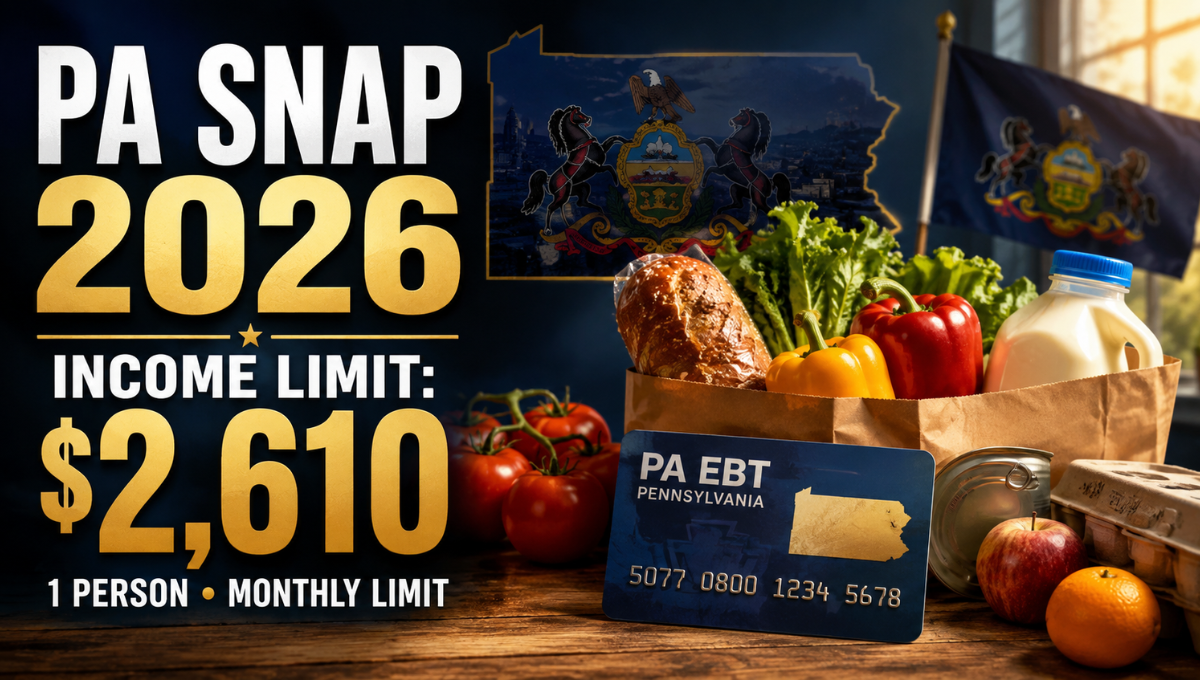
A single person can earn up to $2,610 a month and qualify. A family of four can earn up to $5,360 a month. Pennsylvania also has no asset limit for most households — you can own a home, a car, and have money in savings and still get help.
These numbers are current through September 30, 2026. USDA updates them every October 1, so a new set of limits is expected within about five weeks of this update. We’ll refresh this page as soon as Pennsylvania DHS publishes the FY2027 figures.
Quick Facts About PA SNAP in 2026
- Pennsylvania’s income limit is 200% of the federal poverty guidelines
- A single person can earn up to $2,610 per month and qualify
- A family of four can earn up to $5,360 per month and qualify
- Maximum benefit for one person: $298 per month
- Maximum benefit for four people: $994 per month
- No asset test for most households — you can own a home and a car
- New limits take effect October 1, 2026
Pennsylvania residents can check SNAP eligibility online or compare SNAP income limits across all 50 states.
Pennsylvania SNAP Income Limits 2026
Pennsylvania uses Broad-Based Categorical Eligibility (BBCE). This state policy raises the income limit well above the federal minimum of 130% of the poverty level.
Pennsylvania sets its gross income limit at 200% of the federal poverty guidelines. These figures are effective October 1, 2025 through September 30, 2026.
Gross Income Limits (200% of Poverty)
| Household Size | Monthly Income Limit |
|---|---|
| 1 person | $2,610 |
| 2 people | $3,526 |
| 3 people | $4,442 |
| 4 people | $5,360 |
| 5 people | $6,276 |
| 6 people | $7,192 |
| 7 people | $8,110 |
| 8 people | $9,026 |
| Each additional person | Add $918 |
Source: Pennsylvania Department of Human Services — SNAP Income Limits
A single person earning $2,610 a month qualifies in Pennsylvania. The standard federal limit (130% FPL) is only about $1,696 a month for one person — Pennsylvania’s threshold is significantly higher.
Net Income Limits (100% of Poverty)
Some households must also meet a net income test. Net income is what’s left after allowable deductions are subtracted from gross income.
| Household Size | Net Income Limit |
|---|---|
| 1 person | $1,305 |
| 2 people | $1,763 |
| 3 people | $2,221 |
| 4 people | $2,680 |
| 5 people | $3,138 |
| 6 people | $3,596 |
| 7 people | $4,055 |
| 8 people | $4,513 |
| Each additional person | Add $459 |
Most households that pass the 200% gross income test also need to pass this 100% net income test before benefits are approved.
Maximum SNAP Benefits in Pennsylvania 2026
SNAP maximum benefit amounts increased on October 1, 2025, under USDA’s annual cost-of-living adjustment (COLA). These are the highest amounts a household can receive — most households get less, because the formula subtracts 30% of your net income from the maximum.
Maximum Monthly Benefits
| Household Size | Maximum Benefit |
|---|---|
| 1 person | $298 |
| 2 people | $546 |
| 3 people | $785 |
| 4 people | $994 |
| 5 people | $1,183 |
| 6 people | $1,421 |
| 7 people | $1,571 |
| 8 people | $1,789 |
| Each additional person | Add $218 |
Source: USDA Food and Nutrition Service — SNAP FY2026 Cost-of-Living Adjustments
One-person maximum benefits rose $6 and four-person maximum benefits rose $19 compared to FY2025.
Pennsylvania’s No-Asset Policy
Pennsylvania eliminated the asset test for most SNAP households. Many other states still count savings and vehicle value against eligibility — Pennsylvania generally does not.
Under this policy, most Pennsylvania households can qualify for SNAP even if they:
- Own their home
- Have money in the bank
- Own multiple vehicles
- Have retirement savings
Exception: if your household doesn’t have earned income, children, or an elderly/disabled member and your gross income exceeds the 200% limit, or if you’re applying under the separate federal pathway described below, an asset test can still apply. For nearly everyone else, meeting the income limits is the only requirement.
SNAP Eligibility for Elderly and Disabled Households
Pennsylvania households with a member age 60 or older, or a member with a qualifying disability, have an additional path to eligibility if their gross income is above the 200% limit.
Under standard federal SNAP rules (not the BBCE pathway above), these households can still qualify by meeting:
- The net income test (100% of poverty, same chart as above), and
- An asset limit of $4,500 — a higher limit than the standard federal $3,000 asset cap that applies in states without BBCE
This matters because it means a senior or disabled applicant who’s just over Pennsylvania’s 200% gross limit isn’t automatically denied — a caseworker can evaluate net income and countable assets instead. Vehicles are treated favorably in this test too: one household vehicle, and any vehicle used to produce income, isn’t counted at all; for other vehicles, only the value above roughly $4,650 counts against the limit.
This is a genuinely useful nuance that gets missed in a lot of online SNAP guides — if you’re 60+ or have a disability and think you’re “over the limit,” it’s still worth applying.
Income Deductions That Lower Your Net Income
Pennsylvania allows several deductions before calculating your net income and benefit amount.
Standard Deduction
Every household gets a standard deduction, no receipts required:
| Household Size | Standard Deduction |
|---|---|
| 1–3 people | $209 |
| 4 people | $223 |
| 5 people | $261 |
| 6+ people | $299 |
Earned Income Deduction
You can subtract 20% of all earned income from work or self-employment before it counts toward your net income.
Other Deductions
- Dependent care costs: Childcare or adult care expenses needed for work, training, or school
- Medical expenses: Out-of-pocket costs above $35/month for household members age 60+ or with a disability
- Shelter costs: Rent, mortgage, property taxes, and utilities — capped at $744/month for non-elderly, non-disabled households (no cap for elderly/disabled households)
- Homeless shelter deduction: Up to $198.99/month if you have some housing costs but no fixed address
- Child support: Court-ordered payments made to people outside your household
Pennsylvania uses Standard Utility Allowances (SUA) instead of requiring actual utility bills, which simplifies the application.
How SNAP Benefits Are Calculated
Pennsylvania — like every state — uses this federal formula:
Maximum Benefit − (30% of Net Income) = Your Monthly Benefit
Example Calculation
A family of four earns $3,000 a month in gross income and has $500 in total deductions.
- Gross income: $3,000
- Minus deductions: $500
- Net income: $2,500
- 30% of net income: $750
- Maximum benefit for 4 people: $994
- Monthly SNAP benefit: $994 − $750 = $244
A household with $0 net income after deductions receives the full maximum benefit for its size.
SNAP Work Requirements in Pennsylvania
Pennsylvania’s countywide work-requirement waiver ended September 1, 2025, and stricter rules have applied statewide since November 1, 2025.
Who Must Meet the Work Requirement?
Adults ages 18–64 must meet a work requirement if they:
- Have no dependent children under age 14 in the household, and
- Are physically and mentally able to work
What the Requirement Involves
You must complete 20 hours a week (about 80 hours a month) of one or more of the following:
- Paid employment
- Approved volunteer work
- A job training program
- An education program tied to employment
If you don’t meet this requirement, SNAP is generally limited to 3 months within a 3-year period.
Source: Pennsylvania DHS — SNAP Work Requirements
Exemptions
You’re exempt from the work requirement if you:
- Live with a dependent child under age 14
- Are pregnant
- Can’t work due to a physical or mental health condition
- Care for an ill or disabled household member
- Receive unemployment benefits
- Are experiencing domestic violence
- Are in a substance abuse treatment program
- Are experiencing homelessness
- Expect to return to work within 60 days
Student Eligibility for SNAP in Pennsylvania
Pennsylvania has expanded SNAP access for college students beyond the federal minimum.
You may qualify as a student if you:
- Attend high school
- Are enrolled less than half-time in college
- Work at least 20 hours a week
- Participate in a work-study program
- Are under 18 or age 50+
- Can’t work due to a disability
- Are enrolled in a community college career program or a course leading to a High Priority Occupation
Note: students with a meal plan that provides more than 10 meals a week generally can’t receive SNAP.
How to Apply for SNAP in Pennsylvania
Application Methods
- Online: Apply through MyCOMPASS PA
- In person: Visit your local County Assistance Office
- Mail or fax: Download and submit a paper application
Documents You’ll Need
- Proof of identity (driver’s license or state ID)
- Proof of residence (utility bill or lease)
- Social Security numbers for all household members
- Proof of income (pay stubs from the last 30 days)
- Proof of expenses (rent, utilities, childcare bills)
Processing Times
- Regular applications: up to 30 days
- Expedited applications: as fast as 5 days for emergencies
You may qualify for expedited processing if:
- Your monthly income is under $150 and you have less than $100 in cash, OR
- Your housing costs exceed your monthly income
Interview Requirement
Pennsylvania DHS will call within 2 business days of your application to complete a required phone interview. If you miss the call, they’ll mail you a notice to reschedule.
Background: Why the Rules Changed in 2025
Two federal and state policy shifts are still shaping Pennsylvania SNAP eligibility today.
The One Big Beautiful Bill Act (OBBBA)
Signed July 4, 2025, this federal law changed SNAP nationwide effective September 1, 2025:
- Expanded work requirements to adults ages 55–64
- Narrowed the “dependent child” exemption from under 18 to under 14
- Ended Pennsylvania’s countywide work-requirement waiver
- Removed some previous exemptions for veterans and former foster youth
Source: Philadelphia DHS — SNAP Benefit Changes
Non-Citizen Eligibility Changes
Some immigrants lost SNAP eligibility on November 1, 2025. Groups that generally still qualify include refugees, permanent residents who’ve lived in the U.S. for 5+ years, and certain individuals from Cuba or Haiti.
Will Pennsylvania Restrict Soda and Candy Purchases?
Several states have received USDA waivers in 2026 to block SNAP purchases of soda, candy, and other sweetened items. As of this update, Pennsylvania has not received an approved waiver, though state lawmakers requested one in 2025.
If that changes, it will affect what you can buy with your card — not your income eligibility. See our full state-by-state timeline for the current list of states with approved restrictions.
How Pennsylvania Compares to Neighboring States
Pennsylvania’s 200% FPL limit is on the generous end nationally, but it’s worth knowing how it stacks up against its neighbors, since BBCE thresholds are a state-by-state policy choice.
| State | BBCE Gross Income Threshold | 1-Person Limit | 4-Person Limit |
|---|---|---|---|
| Pennsylvania | 200% FPL | $2,610 | $5,360 |
| New York | 200% FPL | ~$2,610 | ~$5,360 |
| New Jersey | 185% FPL | ~$2,413 | ~$4,957 |
New Jersey uses a somewhat lower threshold than Pennsylvania and New York, so a household earning between roughly $4,957 and $5,360 a month could qualify in Pennsylvania but not in New Jersey. Always confirm current numbers with each state’s own SNAP agency — see our New York SNAP income limits and New Jersey SNAP income limits guides for full details.
Additional Pennsylvania Food Programs
SUN Bucks (Summer EBT)
Children in SNAP households are automatically enrolled for summer meal benefits, worth approximately $120 per child during summer months.
LIHEAP (Heating Assistance)
The Low-Income Home Energy Assistance Program helps with heating and utility costs. The income limit is 150% of the poverty guidelines. LIHEAP assistance can also count toward your SNAP shelter deduction.
Source: Pennsylvania DHS — LIHEAP
Important Notes About SNAP Benefits
Reporting Changes
Report these changes to DHS within 10 days:
- Income going up or down
- Household members moving in or out
- Address changes
- Changes in expenses
Not reporting changes can lead to overpayments that you’re required to repay.
Benefit Distribution
Pennsylvania issues SNAP through EBT cards. Benefits are loaded between the 1st and 15th of each month, based on your case number.
Frequently Asked Questions
What is the income limit for SNAP in Pennsylvania?
Pennsylvania allows gross monthly income up to $2,610 for one person and $5,360 for a family of four. That’s 200% of the federal poverty level — higher than most states.
Does Pennsylvania have an asset limit for food stamps?
No, not for most households. You can own a home, a car, and have savings and still qualify. The main requirement is meeting the income limits. A separate $4,500 asset limit applies only to elderly or disabled households using the alternate federal eligibility pathway.
How much SNAP will I receive in Pennsylvania?
It depends on your net income and household size. Maximum benefits range from $298 for one person to $994 for a family of four. Your actual benefit equals the maximum minus 30% of your net income.
Do I have to work to get SNAP in Pennsylvania?
Adults ages 18–64 without a child under 14 in the household generally must work, volunteer, or train for 20 hours a week. Exemptions apply for pregnancy, disability, and several other circumstances. Without an exemption, benefits are limited to 3 months in a 3-year period.
How long does it take to get approved for SNAP in PA?
Regular applications take up to 30 days. Emergency cases can be approved in as little as 5 days if you have very low income or housing costs that exceed your income. DHS will call within 2 business days for a required phone interview.
When will these limits change again?
USDA updates SNAP income limits and maximum benefits every October 1. The next update is expected October 1, 2026. We’ll update this page as soon as Pennsylvania DHS publishes the new figures.
Summary
Pennsylvania’s SNAP program is among the most generous in the country. Households can earn up to 200% of the federal poverty level and still qualify.
Key advantages:
- Higher income limits than the federal standard
- No asset test for most households
- Expanded student eligibility
- An additional net-income/asset pathway for elderly and disabled households who exceed the standard limit
- Automatic qualification for most TANF and SSI recipients
Work requirements took effect November 1, 2025, for able-bodied adults ages 18–64 without young children.
Check your eligibility and apply online through MyCOMPASS PA, or visit your local County Assistance Office for in-person help.
This article is for informational purposes and isn’t a substitute for an official eligibility determination. Figures are sourced from the Pennsylvania Department of Human Services and USDA Food and Nutrition Service and are current as of August 24, 2026. Contact your County Assistance Office or call the PA SNAP hotline for your specific case.