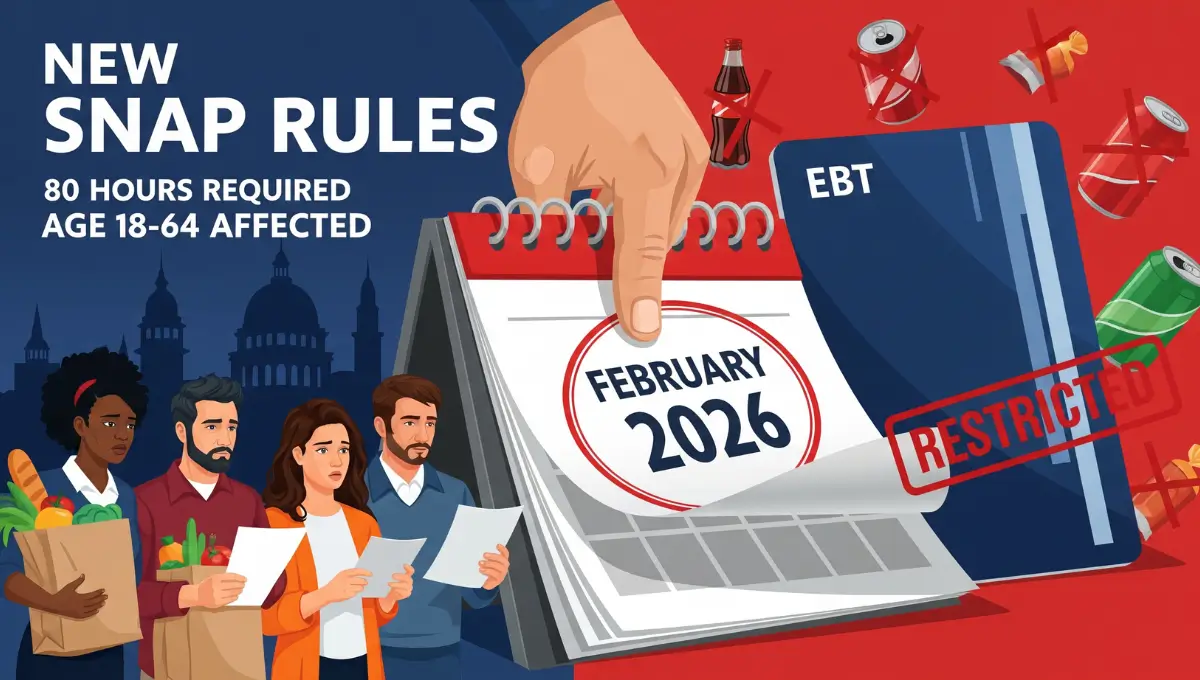
Major changes to SNAP benefits started on February 1, 2026. The One Big Beautiful Bill Act expanded work requirements and changed who qualifies for food assistance.
These new rules affect millions of Americans receiving SNAP benefits.
What’s changing in February 2026:
- Work requirements now apply to adults ages 18–64 (up from 54)
- Families with children under 14 face new work rules
- Three states banned soda and candy purchases with EBT cards
- Benefit amounts increased slightly due to cost-of-living adjustments
- Veterans and homeless individuals lost automatic work exemptions
- States have stricter rules for waiving work requirements
Page Contents
- 1 What Changed on February 1, 2026
- 2 Expanded Work Requirements for SNAP
- 3 How to Apply for Work Exemptions
- 4 State Waiver Restrictions
- 5 February 2026 Benefit Amounts
- 6 New Food Purchase Restrictions
- 7 Other States Rolling Out Restrictions
- 8 Non-Citizen Eligibility Changes
- 9 Quick Comparison Table
- 10 What to Do Right Now
- 11 Frequently Asked Questions
- 11.1 What happens if I don’t meet the 80-hour monthly requirement?
- 11.2 Do volunteer hours count toward the 80-hour requirement?
- 11.3 Can I still buy coffee and tea with SNAP in February 2026?
- 11.4 How do I know if my state waived work requirements?
- 11.5 Are children’s vitamins and supplements still covered by SNAP?
- 11.6 What if I turn 65 in the middle of receiving SNAP benefits?
What Changed on February 1, 2026
The Supplemental Nutrition Assistance Program made sweeping updates this month. The One Big Beautiful Bill Act of 2025 reshaped how SNAP works across all 50 states.
These changes affect work rules, benefit amounts, and purchase restrictions. Some people will lose benefits if they don’t meet new requirements.
Who Is Affected Most
Adults without young children face the biggest impact. If you’re between 18 and 64, you likely need to work or volunteer now.
Parents with teenagers also have new requirements to meet.
Expanded Work Requirements for SNAP
The most significant change involves stricter work mandates for able-bodied adults. These rules determine how long you can receive SNAP benefits without working.
New Age Range: 18 to 64 Years Old
Work requirements previously stopped at age 54. Now they continue until age 65. This adds 10 more years of required work activity.
If you’re in this age range, you must prove work activity. The rules apply unless you qualify for an exemption.
The 80-Hour Monthly Requirement
Adults must complete 80 hours per month to keep benefits. This breaks down to about 20 hours per week. Acceptable activities include:
- Paid employment (any job)
- Approved job training programs
- Volunteer work at qualified nonprofits
- SNAP Employment & Training programs
Missing this requirement means benefits stop after three months. You can only receive SNAP for three months in a three-year period without meeting work rules.
Who Lost Automatic Exemptions
Previously exempt groups now must work or qualify differently:
- Veterans: Must now meet work requirements or prove disability
- Homeless individuals: No longer automatically exempt from work rules
- Former foster youth: Those aged 24 or younger must work or train
These changes took effect immediately on February 1, 2026.
New Caregiver Age Limits
Parents and caregivers face tighter exemption rules. You’re only exempt from work requirements if your youngest child is under age 14.
Previously, having any child under 18 exempted you. Now teenagers aged 14–17 don’t count for this exemption. Single parents with high schoolers must work 80 hours monthly.
How to Apply for Work Exemptions
You can avoid work requirements if you qualify for Good Cause exemptions. Your state SNAP agency handles these requests.
Step 1: Identify Your Exemption Category
Common exemptions include:
Medical exemptions: Physical or mental health prevents work. Requires a Medical Report Form signed by your doctor.
Caregiver exemptions: You care for a child under 14 or an incapacitated adult family member.
Student exemptions: Enrolled at least half-time in recognized school or training programs.
Pregnancy: Automatically exempt during pregnancy and postpartum period.
Step 2: Submit Required Proof
Most states require formal documentation now. You’ll need a Self-Attestation Form or attend a verification interview.
States like Illinois and Florida require updated documentation every recertification period. Don’t assume your old exemption still applies.
Step 3: Use Your State’s SNAP Portal
Submit documents through official state websites:
- Texas: YourTexasBenefits portal
- Pennsylvania: COMPASS system
- Virginia: CommonHelp website
- California: CalFresh online application
Upload documents as soon as you receive work requirement notices. Processing can take 10–30 days depending on your state.
State Waiver Restrictions
States have less power to bypass federal work rules. The February 2026 changes limited when states can request waivers.
10% Unemployment Threshold
States can only waive work requirements in areas with unemployment at or above 10%. Most areas don’t qualify under this strict standard.
Previously, states had flexibility with lower unemployment rates. This change forces stricter enforcement nationwide.
Increased Administrative Costs
States now pay 75% of SNAP administrative costs. The federal government covers only 25%. This is up from a 50/50 split.
Higher costs may reduce state staffing and services. Some states are cutting SNAP office hours and outreach programs.
February 2026 Benefit Amounts
SNAP benefits increased slightly due to the 2026 Cost-of-Living Adjustment. These amounts reflect inflation adjustments to the Thrifty Food Plan.
Maximum Monthly Allotments
Here are the new maximum benefits for households:
| Household Size | Maximum Monthly Benefit |
|---|---|
| 1 person | $298 |
| 2 people | $546 |
| 3 people | $785 |
| 4 people | $994 |
| Each additional person | Add $218 |
Your actual benefit depends on your income and expenses. Use a SNAP eligibility calculator 2026 to estimate your household amount.
Asset Limits Remain Unchanged
Most households can have up to $3,000 in countable assets. Households with elderly or disabled members can have up to $4,500.
Your home and one vehicle typically don’t count toward these limits. Check SNAP income limits by state in 2026 for detailed eligibility requirements.
New Food Purchase Restrictions
Three states implemented bans on certain foods in February 2026. Your EBT card will automatically decline these items at checkout.
Idaho (Effective February 15)
Banned items include:
- Carbonated sodas with natural or artificial sweeteners
- Candy of all types
Oklahoma (Effective February 15)
Prohibited purchases include:
- Soft drinks (all carbonated beverages)
- Candy and gum
Louisiana (Effective February 18)
Louisiana has the strictest new rules. Banned items include:
Soft drinks: Any carbonated non-alcoholic drink with high-fructose corn syrup or artificial sweeteners. Flavored carbonated waters like LaCroix are still allowed.
Energy drinks: Beverages with added stimulants including taurine, guarana, or fortified caffeine. Brands like Red Bull and Monster are prohibited.
Candy: Includes gum, mints, and chocolate bars. Protein bars and baking chocolate remain eligible.
The Louisiana Department of Health maintains a list of over 25,000 ineligible products. Residents can check the official LDH SNAP Guide before shopping.
What You Can Still Buy
All states allow these essential food items:
- Fruits and vegetables (fresh, frozen, canned)
- Meat, poultry, and fish
- Dairy products (milk, cheese, yogurt)
- Breads and cereals
- Seeds and plants that produce food
Other States Rolling Out Restrictions
More states are implementing similar bans throughout 2026.
Already Active (Started January 1, 2026)
- Indiana
- Iowa
- Nebraska
- Utah
- West Virginia
Coming Soon (Spring/Summer 2026)
- Colorado: March 2026
- Texas: April 2026
- Virginia: April 2026
- Florida: April 2026
- Arkansas: July 2026
Check your state’s SNAP website for updates on food restrictions. Rules can change with short notice.
Non-Citizen Eligibility Changes
SNAP eligibility for non-citizens became more restrictive on February 1, 2026.
Who Still Qualifies
Only specific immigration categories remain eligible:
- Lawful Permanent Residents (LPRs): Usually after a five-year waiting period
- Cuban and Haitian Entrants: No waiting period required
- COFA migrants: Citizens of Freely Associated States qualify immediately
Who Lost Eligibility
Individuals present for urgent humanitarian reasons may no longer qualify. This includes some survivors of human trafficking.
If you’re uncertain about your status, contact your local SNAP office immediately. Immigration status rules are complex and fact-specific.
Quick Comparison Table
Here’s how the rules changed:
| Category | Previous Rule | New Rule (Feb 2026) |
|---|---|---|
| Maximum work age | 54 years old | 64 years old |
| Child exemption | Child under 18 in home | Child under 14 in home |
| State waivers | Flexible (low employment) | Only if unemployment ≥ 10% |
| State cost share | 50% State / 50% Federal | 75% State / 25% Federal |
| Veterans exemption | Automatic | Must prove disability |
| Homeless exemption | Automatic | Must meet work rules |
What to Do Right Now
Take these immediate steps if you receive SNAP benefits:
Check your mail: Look for work requirement notices from your state. These explain your specific obligations.
Verify your exemptions: If you have medical conditions or caregiving responsibilities, update your caseworker now.
Track your hours: Start documenting work, volunteer, or training hours immediately.
Know your payment dates: Check SNAP February 2026 payment dates by state to plan your budget.
Louisiana residents: If you shop after February 18, know that soda and candy require separate payment.
Frequently Asked Questions
What happens if I don’t meet the 80-hour monthly requirement?
Your SNAP benefits will stop after three months. You won’t qualify again until you complete work hours or a three-year period passes. Apply for exemptions immediately if you cannot work.
Do volunteer hours count toward the 80-hour requirement?
Yes, volunteer work at qualified nonprofit organizations counts. Your organization must verify your hours through your state SNAP office. Job training programs also count toward the requirement.
Can I still buy coffee and tea with SNAP in February 2026?
Yes, coffee and tea remain eligible in all states. The new restrictions only apply to sodas, energy drinks, and candy in specific states. Regular beverages are not affected.
How do I know if my state waived work requirements?
Check your state SNAP website or call your local office. Waivers only apply in areas with 10% or higher unemployment. Most areas don’t qualify under the new strict rules.
Are children’s vitamins and supplements still covered by SNAP?
No, SNAP never covered vitamins or supplements. Only foods for household consumption are eligible. Medicine and supplements require separate payment regardless of state.
What if I turn 65 in the middle of receiving SNAP benefits?
Work requirements automatically end when you turn 65. Notify your caseworker of your birthday. You’ll receive an exemption without needing to reapply or submit documentation.
Last Updated: February, 2026
Sources:
- U.S. Department of Agriculture Food and Nutrition Service (USDA FNS)
- Louisiana Department of Health SNAP Rules
- One Big Beautiful Bill Act of 2025 (Public Law)