Last Updated: March 1, 2026
March 2026 brings big changes to the Supplemental Nutrition Assistance Program (SNAP). New work requirements take effect March 1, 2026, in several states.
Benefit amounts stay at FY 2026 levels set by the October 2025 Cost-of-Living Adjustment (COLA).
Here is what you need to know:
- New ABAWD work rules start March 1 in New York, Nevada, and other states
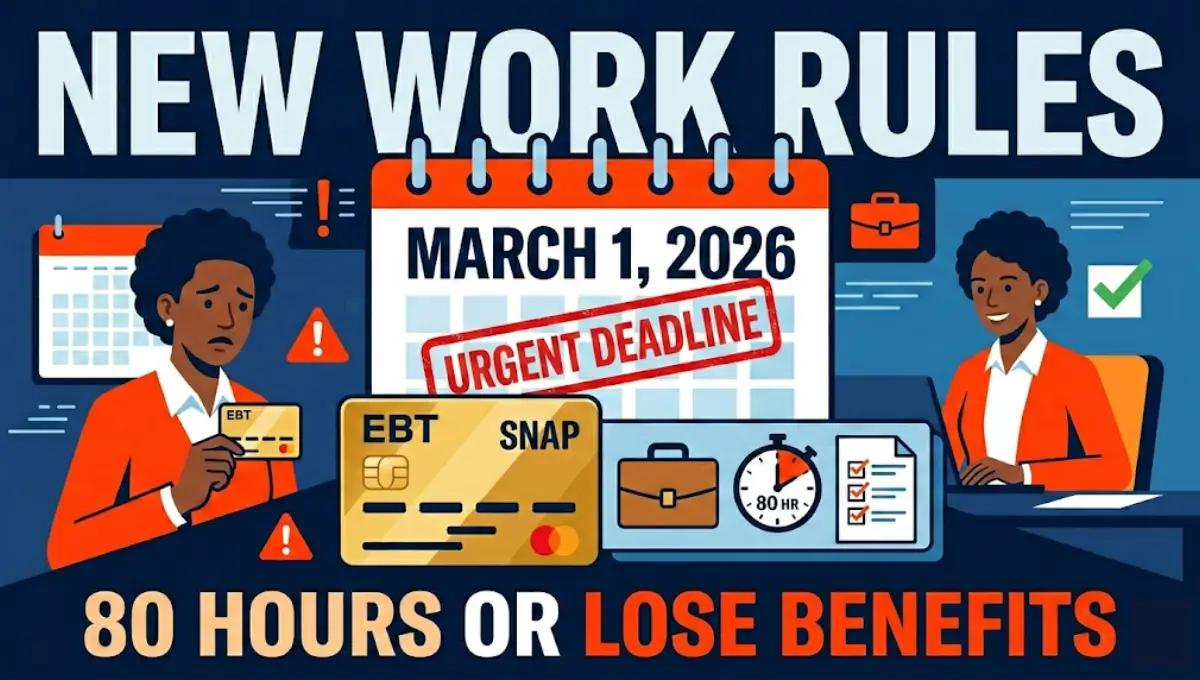
- Adults ages 18–64 without dependents must now work 80 hours per month
- Maximum SNAP benefit for a family of four is $994 per month
- Food purchase restrictions now apply in 18 states
- Connecticut changed its SNAP payment schedule starting March 1
- Pandemic-era waivers officially expire February 28, 2026
Page Contents
- 1 SNAP Payment Dates for March 2026
- 2 The March 1st SNAP Work Requirement Deadline
- 3 March 2026 SNAP Benefit Amounts (FY 2026)
- 4 State-Specific SNAP Updates for March 2026
- 5 Major SNAP Funding and Policy Changes Ahead
- 6 What You Should Do Right Now
- 7 Frequently Asked Questions (FAQs)
- 7.1 What are the new SNAP work requirements starting March 2026?
- 7.2 Will my SNAP benefits increase in March 2026?
- 7.3 What states are enforcing SNAP work rules on March 1, 2026?
- 7.4 Can I lose SNAP benefits in June 2026 for not working?
- 7.5 What food items are restricted under 2026 SNAP rules?
- 7.6 How do I check if I am exempt from SNAP work requirements in 2026?
- 8 Official Resources
SNAP Payment Dates for March 2026
SNAP deposits arrive on different days depending on your state. Most states stagger payments by case number or last name.
Your payment date did not change in most states this month. However, Connecticut recipients should check their new schedule.
For the full list of deposit dates, see the SNAP March 2026 payment dates guide.
Tip: Set up text or email alerts through your state’s SNAP portal. This helps you know exactly when your EBT card is loaded.
The March 1st SNAP Work Requirement Deadline
The biggest March 2026 SNAP change is the enforcement of strict work rules.
This deadline affects able-bodied adults without dependents (ABAWDs) across the country.
The One Big Beautiful Bill Act (OBBBA), signed July 4, 2025, expanded these rules.
Pandemic-era waivers that protected many recipients end on February 28, 2026. Starting March 1, enforcement begins in full.
Who Must Meet the New SNAP Work Requirements?
You must meet work requirements if all of these apply to you:
- You are between 18 and 64 years old
- You do not live with a child under age 14
- You are not pregnant
- You do not have a physical or mental disability
- You are not receiving SSI or disability benefits
The OBBBA raised the age limit from 54 to 64. This means more than 1 million older adults ages 55–64 may now need to prove they are working.
Parents whose youngest child is 14 or older must also meet these rules now. Previously, any parent with a child under 18 was exempt.
The 80-Hour Work Rule Explained
To keep SNAP benefits, ABAWDs must complete 80 hours per month of qualifying activities. That equals about 20 hours per week.
Qualifying activities include:
- Working a paid job (full-time or part-time)
- Volunteering at an approved site
- Participating in a job training program
- Enrolling in a SNAP Employment and Training (E&T) program
- Doing in-kind work (working for goods or services)
- Participating in a WIOA or Trade Act program
Important: Job searching alone does not count unless you are enrolled in an approved training program.
What Happens If You Do Not Meet the Work Requirement?
If you do not meet the 80-hour rule, you can only get 3 months of SNAP benefits in a 36-month (3-year) period. This is called the ABAWD time limit.
Here is the timeline for New York and similar states:
- March 2026 — First month of tracking begins
- April 2026 — Second month
- May 2026 — Third month
- June 2026 — Benefits cut if work hours are not reported for March, April, and May
Once you use your 3 months, you lose SNAP until you either meet the work rule for 30 days or become exempt.
Who Is Exempt from SNAP Work Requirements in 2026?
Not everyone has to meet these rules. You may be exempt if you are:
- Age 65 or older — fully exempt from all work rules
- Pregnant — exempt from ABAWD rules
- Physically or mentally unable to work — requires documentation
- Receiving SSI or disability benefits — from any public or private source
- Caring for a child under 14 in your household
- A student enrolled at least half-time in school
- In a substance abuse treatment program
Note: Under the OBBBA, veterans, people experiencing homelessness, and former foster youth lost their automatic exemptions. These groups must now document their work hours or prove another exemption applies.
If you think you qualify for an exemption, tell your caseworker right away. Bring any medical forms or documents that support your case.
March 2026 SNAP Benefit Amounts (FY 2026)
Monthly SNAP benefit amounts for March 2026 are based on the Fiscal Year 2026 COLA. These amounts took effect on October 1, 2025, and remain steady through September 30, 2026.
The table below shows the maximum monthly allotments for households with zero net income. Most families receive less based on income and deductions. You can check your estimated amount using a SNAP eligibility calculator in 2026 to see where you stand.
Maximum SNAP Benefits for 48 States and D.C.
| Household Size | Maximum Monthly Benefit | Gross Income Limit (130% FPL) |
|---|---|---|
| 1 person | $301 | $1,580 |
| 2 people | $553 | $2,137 |
| 3 people | $793 | $2,694 |
| 4 people | $994 | $3,483 |
| 5 people | $1,182 | $3,839 |
| 6 people | $1,419 | $4,396 |
| 7 people | $1,566 | $4,952 |
| 8 people | $1,793 | $5,509 |
| Each additional person | +$218 | +$557 |
Minimum SNAP benefit: $24 per month for eligible 1–2 person households.
For detailed numbers by location, check the full SNAP income limits by state 2026 guide.
Higher Benefits in Alaska, Hawaii & Territories
SNAP benefits are higher in certain locations due to higher food costs:
| Location | Max Benefit (Family of 4) |
|---|---|
| Alaska | Up to $1,995 |
| Hawaii | $1,689 |
| Guam | $1,465 |
| U.S. Virgin Islands | $1,278 |
Alaska households of four can also qualify earning up to $4,354 per month in gross income. Hawaii’s limit for a family of four is $4,007 per month.
Key SNAP Deductions for FY 2026
Deductions lower your countable income. This can increase your benefit amount.
| Deduction Type | Amount |
|---|---|
| Standard deduction (1–3 people) | $209 |
| Earned income deduction | 20% of earned income |
| Shelter deduction cap | $744 |
| Homeless shelter deduction | $198.99/month |
| Medical expense threshold (age 60+) | Expenses over $35/month |
Asset limits remain at $3,000 for most households. Households with an elderly (60+) or disabled member have a $4,500 asset limit. However, most states use Broad-Based Categorical Eligibility (BBCE), which may raise or remove asset limits entirely.
State-Specific SNAP Updates for March 2026
Federal SNAP rules set the baseline. But states control payment schedules, waiver timelines, and food restrictions. Here are the key state changes this month.
New York SNAP Changes
New York has the largest group of affected SNAP recipients.
- The statewide ABAWD waiver expires February 28, 2026
- Roughly 3 million New Yorkers on SNAP face new requirements
- ABAWDs in all counties (except Saratoga, which lost its waiver earlier) must start meeting work rules March 1
- NYC’s Human Resources Administration (HRA) sends Work Activity Letters to affected recipients
- March is the first month counting toward the 3-month time limit
- Benefits may be cut in June 2026 for those not in compliance
What to do: Log in to ACCESS HRA to check your case status. Update your phone number, email, and address. Report work hours through your career services provider or ACCESS HRA.
Nevada SNAP Changes
Nevada is also enforcing strict ABAWD work rules starting March 1.
- About 44,700 individuals (9% of Nevada’s 505,500 SNAP recipients) are affected
- The Nevada Division of Social Services manages the rollout
- Affected households will receive advance notifications
- Previous exemptions for veterans and homeless individuals now require verification
Connecticut SNAP Schedule Change
Connecticut is changing how it issues SNAP payments.
- Effective March 1, 2026, the Department of Social Services (DSS) issues benefits on new dates
- The change spreads payments more evenly across the month
- Your deposit date may differ from previous months
- Check with CT DSS or your EBT account for your updated date
California (CalFresh) Updates
California’s CalFresh issuance dates remain staggered by case number (March 1–10). However, EBT card skimming remains a serious concern. County offices are prioritizing theft prevention. Protect your card and report suspicious activity immediately.
Food Purchase Restriction States
Under the OBBBA, 18 states received USDA approval to restrict what SNAP recipients can buy. Common restricted items include soda, candy, energy drinks, and certain snack foods.
States with active restrictions (as of March 2026):
- Indiana, Iowa, Nebraska, Utah, West Virginia — active since January 1, 2026
- Colorado — active since March 1, 2026
States implementing restrictions later in 2026:
- Texas — April 1, 2026
- Arkansas — July 1, 2026
- Missouri — October 1, 2026
- Florida, Hawaii, Idaho, Louisiana, North Dakota, Oklahoma, South Carolina, Tennessee, Virginia — dates pending
These restrictions may affect roughly 14 million people across all 18 states. Check your state’s rules before shopping.
Major SNAP Funding and Policy Changes Ahead
The OBBBA made sweeping cuts to SNAP that go beyond work requirements. Here is what is coming:
$186 Billion in Federal SNAP Cuts
The Congressional Budget Office estimates SNAP funding will be reduced by $186 billion through 2034. This is the largest cut to food assistance in U.S. history.
State Cost-Sharing Starts in 2027
Beginning October 2026 (FY 2027), states must pay 75% of SNAP administrative costs. This is a major shift from the current federal funding model.
Payment Error Penalties Begin in 2028
Starting October 2027 (FY 2028), states with SNAP payment error rates above 6% will face financial penalties. Cost shares could range from 5% to 15% depending on how high the error rate is.
Utility Allowance Changes
The Heating and Cooling Standard Utility Allowance is removed from households that do not include someone age 60 or older or a person with a disability. More households must now submit actual utility bills instead of using standard estimates.
If your actual utility costs are lower than previous estimates, your SNAP benefits may decrease.
What You Should Do Right Now
If you receive SNAP benefits, take these steps this month:
- Check your ABAWD status. If you are 18–64, able-bodied, and have no dependents under 14, you may be subject to the new work rules.
- Log your work hours. Make sure you track and report at least 80 hours per month of work, volunteering, or training. Keep pay stubs, employer contact info, and time logs.
- Verify your exemptions. If you are pregnant, disabled, a caregiver, or over 65, make sure your caseworker has this documented.
- Update your contact information. Your state SNAP office needs your current phone number, email, and mailing address to send important notices.
- Check your state’s food restrictions. If your state has a food purchase restriction waiver, learn which items you can no longer buy with EBT.
- Review your benefit amount. Use a SNAP eligibility calculator in 2026 to estimate your monthly benefits after deductions.
Frequently Asked Questions (FAQs)
What are the new SNAP work requirements starting March 2026?
Starting March 1, 2026, able-bodied adults ages 18–64 without dependents under 14 must work, volunteer, or train for 80 hours per month. Those who do not comply can lose benefits after three months. This applies in states where waivers have expired.
Will my SNAP benefits increase in March 2026?
No. SNAP benefits stay at FY 2026 COLA levels set October 1, 2025. A family of four receives up to $994 per month. Benefit amounts only adjust once per year each October.
What states are enforcing SNAP work rules on March 1, 2026?
New York, Nevada, Connecticut, and Washington D.C. are among states implementing or enforcing ABAWD work requirements starting March 1, 2026. Check with your local SNAP office for your state’s specific timeline.
Can I lose SNAP benefits in June 2026 for not working?
Yes. If you are an ABAWD and do not report 80 hours of qualifying work activity in March, April, and May 2026, your SNAP benefits may be cut starting June 2026. You must meet the requirement or qualify for an exemption.
What food items are restricted under 2026 SNAP rules?
In 18 approved states, SNAP cannot be used to buy soda, candy, energy drinks, and certain snack foods. Restrictions vary by state. Colorado’s restrictions begin March 1, 2026. Texas starts April 1, 2026.
How do I check if I am exempt from SNAP work requirements in 2026?
Contact your local SNAP office or log in to your state benefits portal. You may be exempt if you are over 65, pregnant, disabled, receiving SSI, or caring for a child under 14. Documentation is required.
Official Resources
- USDA Food and Nutrition Service — SNAP
- FY 2026 SNAP COLA Information
- SNAP Work Requirements — USDA FNS
- SNAP Food Restriction Waivers — USDA
This article provides general information about SNAP benefits for March 2026. Eligibility rules vary by state. Contact your local SNAP office or visit your state’s benefits portal for personalized assistance. Data sourced from the USDA Food and Nutrition Service, state SNAP agencies, and the Congressional Budget Office.