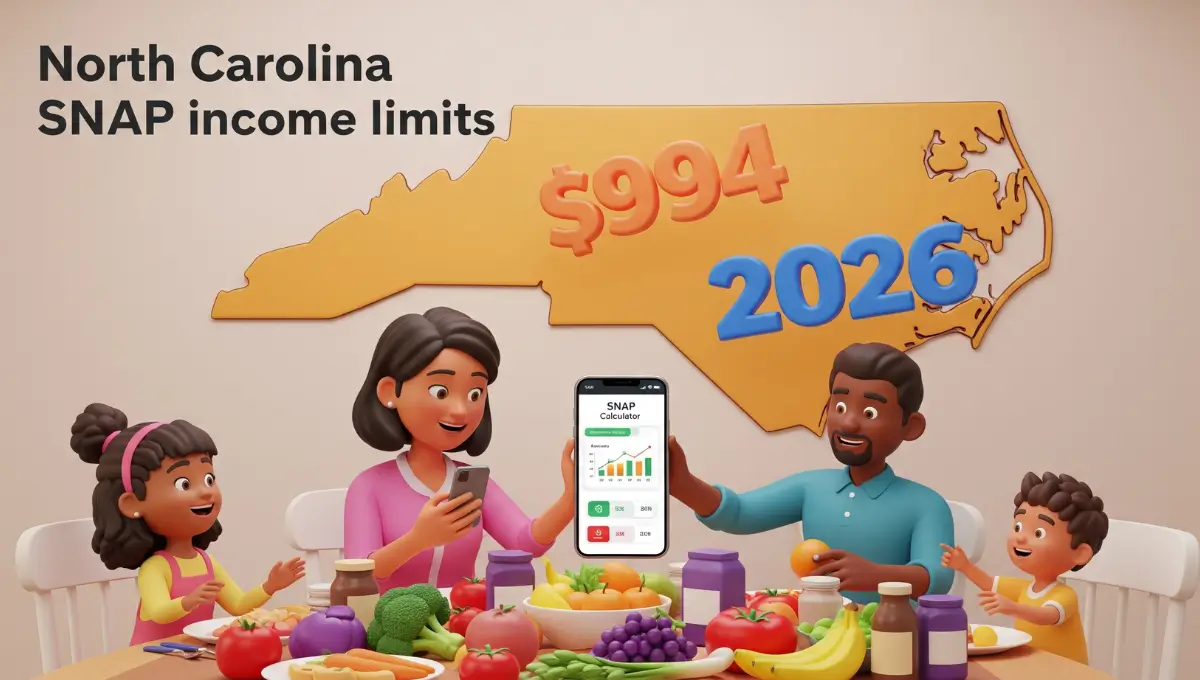
North Carolina SNAP income limits for FY2026 (October 1, 2025 – September 30, 2026) have been updated with new cost-of-living adjustments.
North Carolina is one of the most generous states for SNAP eligibility, utilizing expanded eligibility at 200% of the federal poverty level for all households.
Key Points About 2026 NC SNAP Income Limits
- Gross income limit: $2,608/month for 1 person, $5,358/month for family of 4 (200% FPL)
- Net income limit: $1,304/month for 1 person, $2,679/month for family of 4 (100% FPL)
- Maximum SNAP benefits: $298/month for 1 person, $994/month for family of 4
- Asset limits: No asset limit for most households; $4,500 for elderly/disabled households using alternative eligibility path
- Minimum benefit: $24/month for eligible 1-2 person households
For personalized calculations, check the North Carolina SNAP calculator to estimate your benefits.
Page Contents
- 1 2026 NC SNAP Gross Income Limits (200% FPL)
- 2 NC SNAP Net Income Requirements
- 3 Eligibility Test Requirements
- 4 Maximum SNAP Benefits in North Carolina 2026
- 5 NC SNAP Deductions for 2026
- 6 Asset Limits for NC SNAP 2026
- 7 Special Income Rules
- 8 How to Apply for NC SNAP
- 9 Changes from FY2025
- 10 Upcoming Policy Changes
- 11 Why North Carolina’s Policy Matters
- 12 Frequently Asked Questions
- 13 Conclusion
2026 NC SNAP Gross Income Limits (200% FPL)
North Carolina applies 200% of the federal poverty level as the gross income limit for all households, making it significantly more generous than the federal standard of 130%. Your household’s gross monthly income must be at or below 200% of the federal poverty level.
| Household Size | Monthly Gross Income Limit (200% FPL) |
|---|---|
| 1 person | $2,608 |
| 2 people | $3,526 |
| 3 people | $4,442 |
| 4 people | $5,358 |
| 5 people | $6,276 |
| 6 people | $7,192 |
| 7 people | $8,108 |
| Each additional | Add $916 |
NC SNAP Net Income Requirements
Net income is your gross income minus allowed deductions. Net monthly income must not exceed 100% of the federal poverty level and is used to calculate your actual benefit amount.
| Household Size | Monthly Net Income Limit (100% FPL) |
|---|---|
| 1 person | $1,304 |
| 2 people | $1,763 |
| 3 people | $2,221 |
| 4 people | $2,679 |
| 5 people | $3,138 |
| 6 people | $3,596 |
| 7 people | $4,054 |
| Each additional | Add $458 |
Eligibility Test Requirements
North Carolina’s eligibility structure varies based on household composition:
All households must meet the 200% gross income limit shown above.
Households with members 60+ or with disabilities who exceed the gross income limit can alternatively qualify by meeting the Net Income and Asset tests without a gross income limit.
Households without elderly or disabled members typically must meet both the gross income test (200% FPL) and may need to meet net income requirements depending on their circumstances.
Maximum SNAP Benefits in North Carolina 2026
The maximum monthly SNAP allotments increased for FY2026. These are the highest benefit amounts your household can receive.
| Household Size | Maximum Monthly Benefits | Increase from FY2025 |
|---|---|---|
| 1 person | $298 | +$6 |
| 2 people | $546 | +$10 |
| 3 people | $785 | +$17 |
| 4 people | $994 | +$19 |
| 5 people | $1,183 | +$25 |
| 6 people | $1,421 | +$31 |
| 7 people | $1,571 | +$35 |
| Each additional | +$218 | -$2 |
NC SNAP Deductions for 2026
Standard Deductions
North Carolina SNAP households receive automatic deductions from gross income:
- Households 1-3 people: $209/month
- Households 4+ people: Higher amounts based on household size
Shelter Cost Deductions
- Maximum shelter deduction: $744/month for households without elderly or disabled members
- Unlimited shelter deduction: For households with members 60+ or with disabilities
- Homeless shelter deduction: $198.99/month (maximum)
Shelter expenses include rent, mortgage, homeowners insurance, and utilities. The deduction applies when shelter costs exceed 50% of household income after other deductions.
Medical Expense Deductions
Households with members 60+ or with disabilities can deduct out-of-pocket medical expenses exceeding $35 per month.
Dependent Care Deductions
Actual costs for care of children or disabled adults when necessary for work, training, or education are fully deductible.
Utility Allowances
Households can claim one standard utility allowance based on bills paid (heating/cooling, basic utilities, or single utility).
Asset Limits for NC SNAP 2026
North Carolina has significantly relaxed asset requirements:
- Most NC households: No asset limit
- Elderly/disabled households (using alternative eligibility path): $4,500 in countable assets
Countable resources include bank account funds. Your home and vehicles are excluded from asset calculations.
Special Income Rules
Elderly and Disabled Households
If your household includes someone 60+ or disabled, different rules may apply:
- Alternative eligibility path with no gross income limit (must meet net income and asset tests)
- Higher asset limits ($4,500) if using alternative path
- Unlimited shelter deductions
- Additional deductions for medical expenses over $35
Work Requirements
Most able-bodied adults 18-54 without dependents (ABAWDs) must:
- Work 20+ hours weekly, or
- Participate in approved training programs
- Limited to 3 months of benefits in 36-month period if not working
Note: Work requirements may change in 2026 under Budget Reconciliation Act provisions.
How to Apply for NC SNAP
You can apply for North Carolina food stamps through:
- Online: NC Department of Health and Human Services website
- In-person: Local DSS offices
- Phone: Contact your county DSS office
- Mail: Download and submit paper application
Required documents include proof of income, identity, residency, and household expenses.
Changes from FY2025
The FY2026 cost-of-living adjustment brought modest increases:
- Gross income limits (200% FPL) rose by approximately $98-$218 per month depending on household size
- Four-person household limit increased from $5,200 to $5,358 (3.0% increase)
- Maximum benefit for four-person household increased from $975 to $994 (+$19)
- Shelter cap increased to $744 for non-elderly/non-disabled households
Upcoming Policy Changes
North Carolina SNAP recipients may face benefit adjustments in November 2025 due to the One Big Beautiful Bill Act passed in 2025. Changes will primarily affect households that:
- Do not pay separate heating or cooling bills
- Have no members 60+ or with disabilities
- Currently receive LIHEAP (Low Income Home Energy Assistance Program) assistance
These changes could reduce benefits for working families who receive energy assistance but don’t directly pay utility bills.
Why North Carolina’s Policy Matters
North Carolina’s 200% FPL gross income limit represents one of the most expansive SNAP eligibility policies in the United States. This policy significantly exceeds the federal standard of 130% FPL, allowing households earning nearly double the poverty level to qualify for assistance. This particularly benefits working families with moderate incomes who still struggle with food insecurity.
The elimination of asset limits for most applicants removes traditional barriers that discouraged savings and penalized households with modest emergency funds. This modern approach recognizes that building assets is essential for long-term economic stability.
Frequently Asked Questions
What income counts for NC SNAP eligibility?
All household income counts including wages, unemployment, Social Security, child support, and other benefits. Some deductions are allowed before calculating eligibility.
Can college students get SNAP in NC?
Most college students are ineligible unless they meet specific exemptions like working 20+ hours weekly, caring for dependents, or participating in work-study programs.
How often are NC SNAP benefits paid?
SNAP benefits are loaded monthly on EBT cards. Payment dates vary by case number, typically between the 3rd and 21st of each month.
Do I need to report income changes in NC?
Yes, you must report income increases over $125/month within 10 days. Failure to report can result in overpayments or case closure.
How long does NC SNAP approval take?
Normal applications are processed within 30 days. Expedited applications for emergency situations are processed within 7 days if you qualify.
Can undocumented immigrants get SNAP in NC?
Only eligible immigrants can receive SNAP. However, citizen children in mixed-status families may qualify for benefits based on their own eligibility.
Conclusion
The 2026 NC SNAP income limits provide expanded support for North Carolina families facing food insecurity. With North Carolina’s generous 200% poverty level eligibility threshold, higher maximum benefits, and eliminated asset limits for most households, significantly more working families may now qualify for assistance. If your household income falls within these limits, consider applying for SNAP benefits to help stretch your food budget and ensure adequate nutrition for your family.