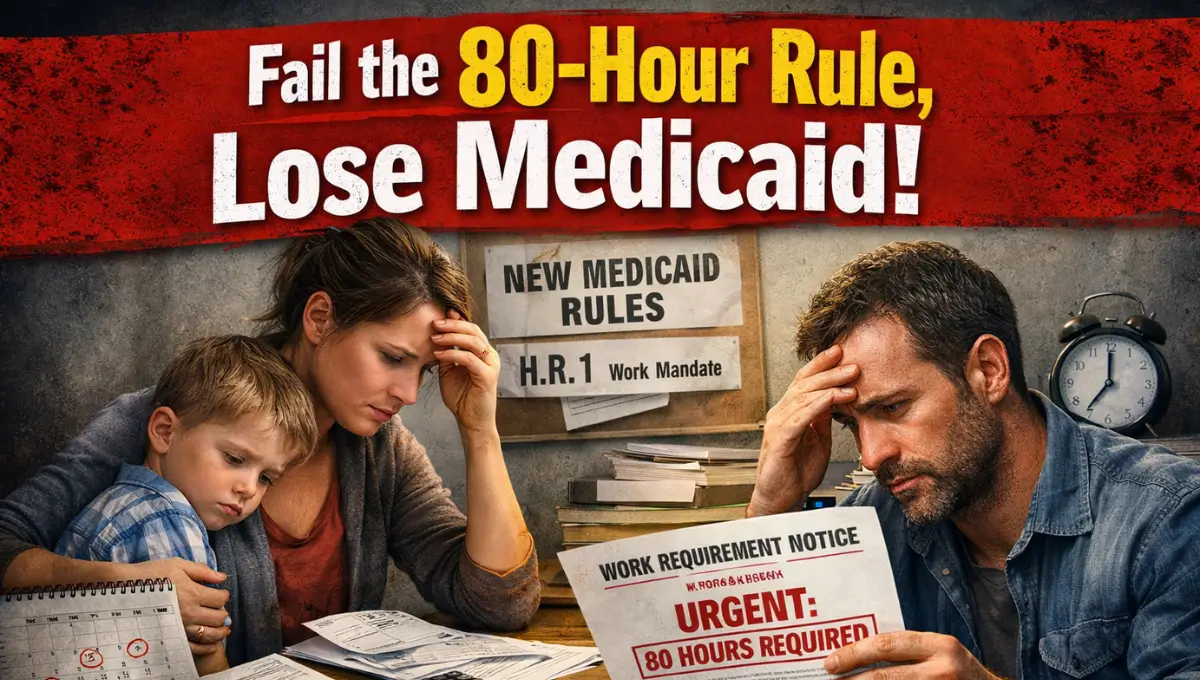
You’re an adult on Medicaid in an expansion state. A new federal law might require you to prove something. You’ll need to show you’re working, volunteering, or going to school.
You’ll need to do this every single month. If you don’t, you could lose your health insurance.
H.R. 1 became law in 2025. It’s called the “One Big Beautiful Bill Act.”
It says certain Medicaid enrollees ages 19-64 must do something.
They must complete 80 hours per month of approved activities. This starts January 2027.
Federal analysts warn over 5 million people could lose coverage by 2034. Not because they’re unemployed.
Because they can’t handle the paperwork.
Here’s what you need to know. Who’s exempt. How to protect your coverage before the deadline.
Page Contents
What the New Law Requires
All 40 Medicaid expansion states must verify something by December 31, 2026.
They must check that “able-bodied” adults are doing approved activities.
These adults can’t have qualifying exemptions. They must complete at least 80 hours per month.
What counts:
- Work (part-time, gig work, or self-employment)
- Community service or volunteer activities
- Job training or job search programs
- Education (half-time in college, trade school, or GED)
This isn’t a suggestion. It’s a federal mandate.
It comes from the Department of Health and Human Services. It applies nationwide to Medicaid expansion populations.
If you don’t report your hours, your state can end your coverage. If you can’t prove them with documents, same thing.
Even if you qualify for an exemption, you need paperwork. The goal is to encourage workforce participation, supporters say.
But health policy researchers warn of something different. Researchers at Kaiser Family Foundation studied this.
So did the Commonwealth Fund.
They say the real impact will be administrative. People will lose coverage because they missed a deadline.
Or didn’t understand the rules. Or couldn’t gather the right documents. Not because they aren’t working.
Who Must Report Hours
You’re subject to work requirements if:
- You’re age 19-64
- You’re enrolled in Medicaid through expansion
- Your income is up to 138% of federal poverty level
- You live in one of 40 expansion states
- You don’t qualify for an exemption
When you must report:
New applicants: You need proof of 80 hours.
From the month before you applied.
Current enrollees: You have a 6-month renewal coming.
You need to show compliance for one month.
Any month within the prior six months.
What counts as proof:
- Pay stubs showing hours worked
- Employer letters
- School enrollment verification and class schedules
- Volunteer logs signed by organizations
- Job training program attendance records
You work multiple part-time jobs? That’s okay.
Do gig work? That counts. Combine volunteering with school? That works too.
You can add hours together to reach 80. But you need documentation for every activity.
States are building online portals for submissions. You’ll upload documents electronically.
Paper submissions by mail also work. Colorado has a portal through their HCPF system.
You can upload documents directly there.
The catch: Missing one renewal deadline triggers automatic termination.
State Medicaid offices report something surprising.
Most people who lose coverage are actually employed.
They just didn’t submit paperwork on time. Or didn’t realize they needed to.
Who Is Exempt (And How to Prove It)
Not everyone has to report hours.
The law includes exemptions for certain people.
People who cannot reasonably meet work requirements.
Due to health, caregiving, or other circumstances.
You’re automatically exempt if you are:
- Pregnant (any stage)
- A parent or guardian of a child under 14
- Some states say under 6—check your state
- Receiving SSI or SSDI (disability benefits)
- Medically frail (serious chronic illness, mental health condition)
- A caregiver for a disabled dependent
- A caregiver for an elderly family member
- A veteran with a service-connected disability
- A former foster youth under age 26
- In substance use treatment or mental health services
You may qualify for a hardship waiver if:
- You were recently hospitalized
- You live in a federally declared disaster area
- You live in a county with unemployment above 8%
- You’re experiencing homelessness
- You’re a victim of domestic violence
The problem: Exemptions aren’t automatic.
You have to apply for them.
You have to provide proof. Catholic Health Association did research on this.
They found 20-30% of people who should qualify get denied. Why? They can’t gather the required documentation.
States often require medical notes from doctors. Unemployment data from specific time periods. Proof of caregiving.
Low-income enrollees can’t easily obtain these things.
If you think you qualify for an exemption, apply early. Don’t wait until your renewal deadline.
How This Works in Your State
All expansion states must comply by January 2027. But states have some flexibility in implementation.
What’s the same everywhere:
- The 80-hour monthly requirement
- The core list of exemptions
- The federal deadline of December 31, 2026
What varies by state:
Reporting frequency: Colorado requires reporting every 6 months.
Texas requires reporting every 2 months. Texas uses a Medicaid waiver for this.
They apply the rule to non-expansion adults.
Grace periods: Some states allow one missed month before termination.
Others don’t allow any grace period.
Hardship waiver approval rates: States with higher unemployment approve more waivers.
States with stricter verification systems deny more.
Portal technology: Rural states got $500 million in federal grants.
From CMS to build verification systems. But some may not be ready by deadline.
Non-expansion states like Texas and Florida will use Section 1115 waivers.
To apply work requirements to similar low-income adults.
Even though they haven’t expanded Medicaid under the Affordable Care Act.
CMS will release detailed state-by-state guidance in June 2026. Until then, contact your state Medicaid office. Confirm your specific rules.
What Happens If You Don’t Comply
You don’t report hours.
Or your state says you didn’t meet 80 hours.
Here’s what happens:
1. You’ll receive a notice.
By mail or email.
Saying you’re out of compliance.
2. You’ll have 10 days to respond.
With documentation or an exemption request.
3. If you don’t respond, your coverage is terminated.
4. You have 90 days to appeal.
But you’ll be uninsured during the appeal process.
Some states may offer a “cure period.”
A one-month grace period to submit late documentation.
But this isn’t guaranteed.
The research is clear: Most people who lose Medicaid are working.
Under work requirements.
They’re just not reporting it correctly.
Kaiser Family Foundation analyzed previous state-level work requirement pilots.
Employment rates didn’t increase.
But coverage losses surged.
In Arkansas, they tested work requirements.
Before a federal court blocked them.
18,000 people lost coverage in six months.
Follow-up surveys found something important.
The vast majority were employed or exempt.
The barrier isn’t employment.
It’s paperwork.
How to Protect Your Coverage Right Now
Don’t wait until 2027 to figure this out.
Start preparing now.
1. Check if you’re exempt.
Use free eligibility calculators on Benefits.gov.
Or your state Medicaid website.
Colorado’s HCPF tool walks you through exemption categories.
It estimates whether you’ll need to report hours.
Based on your household and income.
If you think you qualify for exemption, gather documentation now:
- Medical records showing disability or chronic illness
- Birth certificates proving you have a child under 14
- Caregiver affidavits signed by doctors or social workers
- SSI or SSDI award letters
2. Start tracking your hours.
The requirement doesn’t start until January 2027.
But start documenting your work hours now.
Volunteer hours too.
School hours.
Create a simple log:
- Date
- Activity (work, volunteer, school)
- Hours completed
- Contact person or organization
Keep pay stubs in a dedicated folder.
Timecards too.
Volunteer sign-in sheets.
Class schedules.
Physical or digital folder—both work.
If you do gig work, download monthly earnings summaries.
Uber, DoorDash, freelance—all count.
These count as proof.
3. Update your contact information.
Log into your state Medicaid portal.
Confirm these things:
- Your mailing address is current
- Your email address is correct
- Your phone number is up to date
Opt into electronic notifications.
So you never miss a renewal notice.
4. Submit renewals early.
Your state sends a renewal notice.
Don’t wait until the last day.
Submit your documentation 30-60 days before deadline.
This gives you time to fix errors.
Request exemptions.
Or appeal if your hours aren’t accepted.
5. Use state portals with auto-verification.
Some states are integrating payroll APIs.
They pull your work hours directly from employers.
If your state offers this, enroll.
It eliminates the need for manual documentation.
Ask your employer something.
Do they participate in state workforce data-sharing programs?
6. Track as a family.
Multiple adults in your household on Medicaid?
Coordinate reporting.
Some states allow shared family accounts.
One person can manage renewals for everyone.
Important: Parents lose Medicaid for non-compliance?
Their children’s coverage won’t be affected.
Children’s Medicaid eligibility is separate.
It doesn’t include work requirements.
But if a parent loses coverage, they may not realize something.
Their kids need separate renewals.
This can lead to families accidentally losing coverage.
What Experts Are Saying
Health policy analysts are warning about work requirements.
They’ll reduce coverage without improving employment.
The Commonwealth Fund projects something concerning.
5.3 million adults could lose Medicaid by 2034.
Under full implementation.
Most won’t lose coverage because they’re not working.
They’ll lose it because they can’t navigate reporting.
Research from the Center on Budget and Policy Priorities found something.
People most likely to lose coverage are:
- Shift workers with irregular schedules
- People with limited English proficiency
- Rural residents with limited internet access
- People with undiagnosed disabilities who don’t realize exemptions exist
The Catholic Health Association warns about hospitals.
In low-income areas.
They’ll see spikes in uncompensated care.
As newly uninsured patients delay treatment.
And arrive in emergency rooms with more severe conditions.
The Kaiser Family Foundation emphasizes something important.
Previous work requirement pilots didn’t increase employment.
They just increased administrative burdens.
On both enrollees and state agencies.
The Bottom Line
Medicaid work requirements aren’t about whether you’re working.
They’re about whether you can prove it.
If you’re employed, you’re likely already compliant.
Volunteering? Same thing.
In school? You’re probably fine.
You’re likely already doing what’s required.
The challenge is documentation.
Start preparing now:
- Confirm whether you’re exempt
- Begin tracking your hours
- Update your contact information
- Learn your state’s reporting system
Check your Medicaid eligibility and exemption status now.
Before your state requires it.
Visit Benefits.gov or your state Medicaid website.
Access free tools that estimate your compliance status.
Based on 2026 federal poverty level limits.
The January 2027 deadline is coming.
The more prepared you are, the less likely you’ll face gaps.
Coverage gaps.
Share this article with family, friends, and coworkers on Medicaid.
Millions of people don’t know these requirements are coming.
Early awareness prevents coverage loss.
For state-specific rules, contact your state Medicaid office.
Or visit Medicaid.gov.
Information in this article reflects federal law as of December 2025.
May vary by state implementation.