Last Updated: March 6, 2026
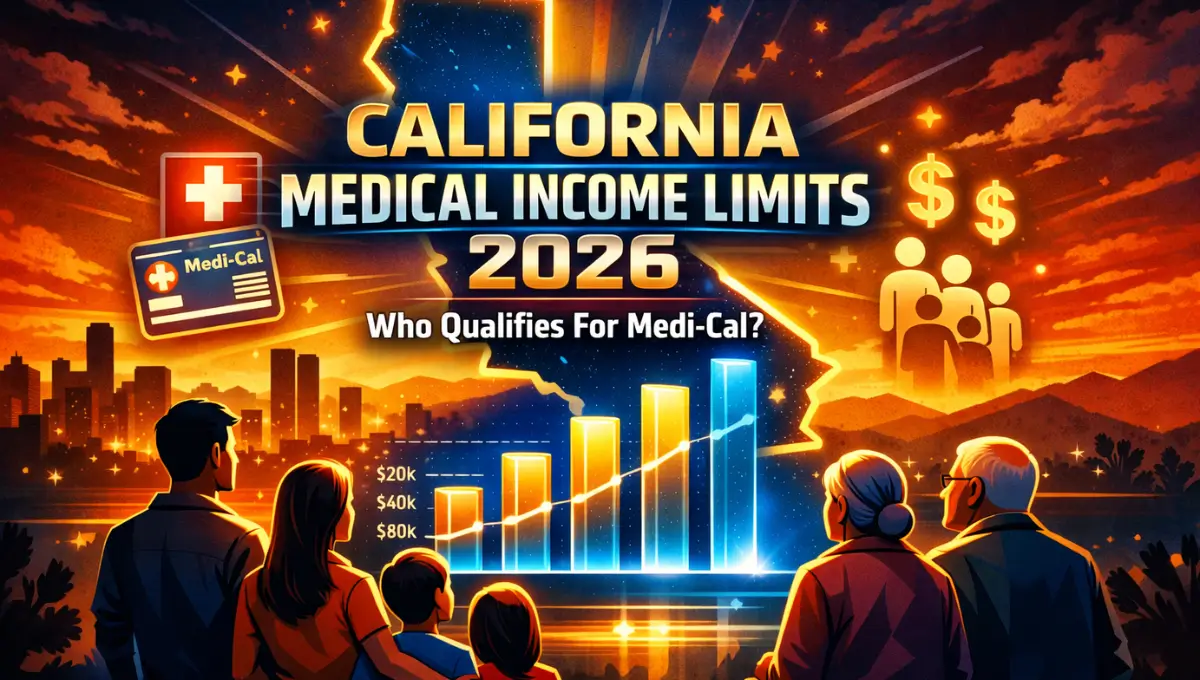
Medi-Cal is California’s free or low-cost health insurance program. In 2026, a single adult can earn up to $22,025 per year ($1,836 per month) and still qualify for Medi-Cal.
A family of four can earn up to $45,540 per year.
Here is a quick summary of this article:
- Medi-Cal covers adults, children, pregnant women, seniors, and people with disabilities in California
- Income limits are based on the 2026 Federal Poverty Level (FPL), effective January 13, 2026
- Asset limits returned on January 1, 2026 — $130,000 for one person and $195,000 for couples
- New work requirements start in January 2027 for adults ages 19–64
- Children qualify with family income up to 266% of the FPL ($87,780 for a family of four)
- You can apply online today at BenefitsCal.com
Page Contents
- 1 What Is Medi-Cal?
- 2 2026 Federal Poverty Level (FPL) for California
- 3 Medi-Cal Income Limits by Category in 2026
- 4 Complete 2026 Medi-Cal Income Limits Table
- 5 How Medi-Cal Measures Your Income (MAGI)
- 6 Medi-Cal Asset Limits in 2026
- 7 Immigration-Related Changes in 2026
- 8 Work Requirements Starting January 2027
- 9 Complete Timeline of Medi-Cal Changes (2026–2028)
- 10 How to Apply for Medi-Cal in 2026
- 11 What to Do If You Are Already on Medi-Cal
- 12 Tips for Seniors and People with Disabilities
- 13 Federal Medicaid Funding Changes
- 14 Frequently Asked Questions
- 14.1 What is the Medi-Cal income limit for a single person in 2026?
- 14.2 Did Medi-Cal asset limits come back in 2026?
- 14.3 Can undocumented immigrants still get Medi-Cal in 2026?
- 14.4 What are the Medi-Cal work requirements in 2026?
- 14.5 How do I apply for Medi-Cal in California in 2026?
- 14.6 Will Medi-Cal have copayments in 2026?
What Is Medi-Cal?
Medi-Cal is California’s version of Medicaid. It is run by the California Department of Health Care Services (DHCS).
The program gives health coverage to millions of low-income Californians.
What Does Medi-Cal Cover?
Medi-Cal covers many health care services. These include:
- Doctor visits and hospital stays
- Prescription drugs
- Mental health and substance use treatment
- Dental and vision care
- Preventive care and checkups
- Long-term care and nursing home services
- Transportation to medical appointments
If you want to check how California compares to other states, see our guide on Medicaid income limits by state in 2026.
2026 Federal Poverty Level (FPL) for California
The Federal Poverty Level sets the income rules for Medi-Cal. The U.S. Department of Health and Human Services (HHS) updates these numbers every year.
The 2026 FPL took effect on January 13, 2026, and reflects a 2.63% increase from the prior year.
2026 FPL by Household Size
| Household Size | 100% FPL (Yearly) | 100% FPL (Monthly) |
|---|---|---|
| 1 | $15,960 | $1,330 |
| 2 | $21,640 | $1,803 |
| 3 | $27,320 | $2,277 |
| 4 | $33,000 | $2,750 |
| 5 | $38,680 | $3,223 |
| 6 | $44,360 | $3,697 |
Source: HHS 2026 Poverty Guidelines, published January 13, 2026.
Medi-Cal uses a percentage of the FPL to set income limits. The percentage depends on your age, health status, and category.
Medi-Cal Income Limits by Category in 2026
Different groups have different income limits. Here is a breakdown of each Medi-Cal category and what you can earn.
Adults (Ages 19–64)
Adults qualify with income at or below 138% of the FPL. This is the standard Medi-Cal expansion group under the Affordable Care Act.
| Household Size | Yearly Income Limit | Monthly Income Limit |
|---|---|---|
| 1 | $22,025 | $1,836 |
| 2 | $29,863 | $2,490 |
| 3 | $37,702 | $3,143 |
| 4 | $45,540 | $3,795 |
| 5 | $53,378 | $4,448 |
| 6 | $61,217 | $5,101 |
If you earn more than $1,836 per month as a single adult, you may qualify for a subsidized plan through Covered California instead.
Children (Ages 0–18)
Children have higher income limits. They qualify with family income up to 266% of the FPL.
| Household Size | Yearly Income Limit |
|---|---|
| 2 | $57,562 |
| 3 | $72,671 |
| 4 | $87,780 |
| 5 | $102,889 |
| 6 | $117,998 |
This means many working families can get free health coverage for their kids even if the parents earn too much for adult Medi-Cal.
Pregnant Women
Pregnant women qualify with income up to 213% of the FPL. The unborn child counts as a household member, which raises the income limit.
| Household Size | Yearly Income Limit | Monthly Income Limit |
|---|---|---|
| 1 (pregnant with first child) | $34,015 | $2,835 |
| 2 | $46,093 | $3,841 |
| 3 | $58,172 | $4,848 |
| 4 | $70,290 | $5,858 |
Pregnancy Medi-Cal covers all pregnancy-related care. Coverage lasts for one full year after the pregnancy ends. Children and pregnant individuals can still enroll regardless of immigration status.
Aged and Disabled (A&D FPL Program)
Californians aged 65 and older or people with disabilities may qualify through the Aged and Disabled FPL program.
- Individual income limit: $1,800 per month
- Couple income limit: $2,433 per month
- Asset limit: $130,000 (individual) / $195,000 (couple)
This program requires meeting the Social Security definition of disability or being 65 or older.
250% Working Disabled Program (WDP)
Working Californians with disabilities can qualify for full Medi-Cal through this program.
- Individual income limit: $3,260 per month (250% FPL)
- Couple income limit: $4,406 per month
- Disability income such as SSDI and Workers’ Compensation does not count toward the limit
You must be working and earning income. Even part-time work counts. To understand how Medi-Cal eligibility works in detail, visit our California Medicaid eligibility 2026 guide.
If your income is above the standard limit, you may still qualify through the Medically Needy program. This works like a deductible.
You pay a “Share of Cost” each month before Medi-Cal kicks in.
The formula works like this:
- Medi-Cal subtracts $600 (individual) or $934 (couple) from your monthly income
- The remaining amount is your Share of Cost
- Once you pay that amount in medical bills, Medi-Cal covers the rest for that month
Complete 2026 Medi-Cal Income Limits Table
This table shows yearly income limits at key FPL percentages. Use it to find which Medi-Cal category fits your household.
| Household Size | 100% FPL | 138% FPL (Adults) | 213% FPL (Pregnant) | 250% FPL (WDP) | 266% FPL (Children) | 400% FPL |
|---|---|---|---|---|---|---|
| 1 | $15,960 | $22,025 | $34,015 | $39,900 | $42,454 | $63,840 |
| 2 | $21,640 | $29,863 | $46,093 | $54,100 | $57,562 | $86,560 |
| 3 | $27,320 | $37,702 | $58,172 | $68,300 | $72,671 | $109,280 |
| 4 | $33,000 | $45,540 | $70,290 | $82,500 | $87,780 | $132,000 |
| 5 | $38,680 | $53,378 | $82,369 | $96,700 | $102,889 | $154,720 |
| 6 | $44,360 | $61,217 | $94,447 | $110,900 | $117,998 | $177,440 |
Source: HHS 2026 Poverty Guidelines and Covered California March 2026 revision.
To quickly check if you qualify, try our Medicaid eligibility calculator for 2026.
How Medi-Cal Measures Your Income (MAGI)
Medi-Cal uses a method called Modified Adjusted Gross Income (MAGI) to check your income. This applies to most non-elderly, non-disabled applicants.
What Counts as MAGI?
MAGI includes your Adjusted Gross Income from your tax return, plus:
- Untaxed foreign income
- Non-taxable Social Security benefits
- Tax-exempt interest
What does NOT count: Supplemental Security Income (SSI) is not included in MAGI.
MAGI is the same method used by the IRS. If you already file taxes, your MAGI number is easy to find on your tax return.
Medi-Cal Asset Limits in 2026
One of the biggest changes in 2026 is the return of asset testing.
From 2024 through 2025, California suspended asset limits for most Medi-Cal programs. Starting January 1, 2026, asset limits are back.
Who Must Meet Asset Limits?
Asset limits apply to these groups:
- Adults aged 65 and older
- People with disabilities (Blind and Disabled categories)
- Medi-Cal with a Share of Cost
- 250% Working Disabled Program
- Long-term care Medi-Cal (nursing homes and waivers)
- Medicare Savings Programs (QMB, SLMB, QI, QDWI)
Important: Standard MAGI Medi-Cal for adults 19–64 and children has NO asset limit. If you qualify based on income alone, your savings and bank accounts do not matter.
2026 Asset Limit Amounts
| Household Members | Asset Limit |
|---|---|
| 1 | $130,000 |
| 2 | $195,000 |
| 3 | $260,000 |
| 4 | $325,000 |
| Each additional member | +$65,000 |
What Counts as an Asset?
Countable assets include:
- Bank accounts and cash
- Stocks, bonds, and investments
- Second homes or rental properties
- Additional vehicles beyond your first car
Exempt assets (do NOT count):
- Your primary home
- One vehicle
- Household items and personal belongings
- Burial plots
- ABLE accounts
- Retirement accounts if taking Required Minimum Distributions
The 30-Month Look-Back Period
If you apply for long-term care Medi-Cal, the state reviews 30 months of your financial history. Gifts, transfers, or trust funding during that period can cause a penalty. This means you could be temporarily disqualified from benefits.
Transfers made during the 2024–2025 suspension window did not trigger penalties. However, unplanned transfers after January 1, 2026 may cause problems.
Spousal Protections
When one spouse needs nursing home care, the other spouse gets financial protection. In 2026, the non-applicant spouse can keep a Monthly Maintenance Needs Allowance (MMNA) of $4,066.50 per month. If the healthy spouse earns less than this, income can be transferred from the applicant spouse.
Immigration-Related Changes in 2026
Several Medi-Cal rules changed for immigrants starting in 2026. These changes affect enrollment, dental coverage, and future premiums.
Enrollment Freeze for Undocumented Adults
Starting January 1, 2026, California froze new full-scope Medi-Cal enrollment for undocumented adults aged 19 and older who are not pregnant. This group can no longer newly enroll in full-scope coverage. They can still get emergency and pregnancy-related Medi-Cal.
If you were already enrolled before January 1, 2026, you can keep your coverage. Just make sure to complete your renewals on time. If your coverage lapses, you have a 90-day grace period to fix it.
Children and Pregnant Women Are Exempt
Income-eligible children (ages 0–18) and pregnant women can still enroll in full-scope Medi-Cal. Immigration status does not matter for these groups. Pregnancy coverage continues for one full year after the pregnancy ends.
Dental Benefit Changes (July 1, 2026)
Starting July 1, 2026, routine dental benefits will end for adult Medi-Cal members (age 19+) who do not have satisfactory immigration status. Emergency dental services like extractions and treatment for severe pain or infections remain covered.
Monthly Premium Starting July 2027
Beginning July 1, 2027, Medi-Cal members ages 19–59 without satisfactory immigration status must pay $30 per month to keep full-scope coverage. If you do not pay, your coverage drops to emergency and pregnancy services only.
Work Requirements Starting January 2027
A major change is coming in January 2027. Under the federal One Big Beautiful Bill Act (H.R. 1), adults ages 19–64 on Medi-Cal must show they are working, in school, or doing approved activities.
How to Meet the Work Requirement
You can meet this requirement by doing any of the following:
- Working at least 80 hours per month
- Earning at least $580 per month
- Being a seasonal worker averaging $580 per month over six months
- Attending school at least half-time
- Participating in an approved volunteer or job training program
Who Is Exempt?
These groups do not need to meet work requirements:
- Tribal members
- Pregnant individuals
- Children under 19
Six-Month Reviews
Adults 19–64 in the MAGI Medi-Cal “New Adult Group” will face reviews every six months instead of every 12 months. This means you must verify your eligibility twice a year.
DHCS estimates that up to 3.4 million Medi-Cal members could be affected. The state is working to automate the process to make it easier.
Complete Timeline of Medi-Cal Changes (2026–2028)
| Date | What Changes |
|---|---|
| January 1, 2026 | Asset limits return ($130,000 individual / $195,000 couple). New enrollment freeze for undocumented adults 19+. |
| March 2026 | Covered California updates income tables to reflect higher 2026 FPL amounts. |
| July 1, 2026 | Dental benefits end for adult members (19+) without satisfactory immigration status. |
| January 2027 | Work requirements begin for adults 19–64. Six-month reviews start for New Adult Group. |
| July 2027 | $30/month premium begins for undocumented adult members ages 19–59. |
| October 2028 | Copayments begin for certain services for adults under 65 without Medicare (capped at 5% of income). |
How to Apply for Medi-Cal in 2026
Applying for Medi-Cal is free. There are several ways to apply.
Online
Visit BenefitsCal.com to apply online. This is the fastest way to get started.
By Phone
Call the Health Consumer Alliance at 1-888-804-3536 for free help with your application.
In Person
Visit your local county Medi-Cal office. You can find your nearest office at DHCS.ca.gov.
Through Covered California
If you are not sure whether you qualify for Medi-Cal or a subsidized plan, visit CoveredCA.com. They will check your eligibility for both programs.
What You Need to Apply
Gather these documents before you start:
- Social Security numbers for all household members
- Proof of income (pay stubs, tax returns)
- Proof of California residency
- Immigration documents (if applicable)
- Information about current health insurance (if any)
To understand how provider payments work under Medi-Cal, check out our article on the California Medicaid fee schedule for 2026. You can also review the national Medicaid fee schedule in 2026 for comparison.
What to Do If You Are Already on Medi-Cal
If you already have Medi-Cal, here are steps to keep your coverage.
Keep Your Information Updated
Make sure your county office has your current address and phone number. This way, you will get renewal notices on time.
Complete Your Renewal on Time
Missing a renewal deadline could cause you to lose coverage. Some groups cannot re-enroll after a lapse.
Check Your Assets
If you are in an asset-tested category (seniors, disabled, long-term care), your assets will be reviewed at your next renewal in 2026. Make sure your countable assets are below the limit.
Keep Using Your Benefits
Continue seeing your doctor and going to medical appointments. Medi-Cal covers many preventive services at no cost.
Tips for Seniors and People with Disabilities
The return of asset limits affects seniors and people with disabilities the most. Here are some action steps.
Review your bank accounts, investments, and properties now. These count toward the $130,000 individual limit. Make sure your retirement accounts are set to take Required Minimum Distributions so they qualify as exempt.
Consider talking to an elder law attorney about protection strategies. Options include Medi-Cal Asset Protection Trusts, ABLE accounts, and proper spend-down planning. Remember the 30-month look-back period for long-term care applications.
Federal Medicaid Funding Changes
The One Big Beautiful Bill Act (H.R. 1) includes roughly $1 trillion in Medicaid cuts over 10 years. The first cuts took effect on January 1, 2026. They removed a temporary financial incentive for states that expanded Medicaid under the Affordable Care Act.
Nursing Home Medicaid is largely protected from future cuts. However, Home and Community Based Services (HCBS) may face funding reductions. This law continues to face legal challenges at both the state and federal level.
Frequently Asked Questions
What is the Medi-Cal income limit for a single person in 2026?
A single adult (ages 19–64) can earn up to $22,025 per year or $1,836 per month. This is 138% of the 2026 Federal Poverty Level. Children and pregnant women have higher limits.
Did Medi-Cal asset limits come back in 2026?
Yes. Starting January 1, 2026, asset limits returned for seniors, people with disabilities, and long-term care applicants. The limit is $130,000 for one person and $195,000 for couples. Standard adult Medi-Cal has no asset limit.
Can undocumented immigrants still get Medi-Cal in 2026?
New full-scope enrollment froze on January 1, 2026 for undocumented adults 19+. Those already enrolled can keep coverage by renewing on time. Children and pregnant women can still enroll regardless of immigration status.
What are the Medi-Cal work requirements in 2026?
Work requirements begin in January 2027, not 2026. Adults ages 19–64 must work 80 hours per month, earn $580 per month, or participate in school or approved training. Tribal members, pregnant individuals, and children are exempt.
How do I apply for Medi-Cal in California in 2026?
Apply online at BenefitsCal.com, call the Health Consumer Alliance at 1-888-804-3536, or visit your local county Medi-Cal office. You can also apply through CoveredCA.com.
Will Medi-Cal have copayments in 2026?
No. Copayments are scheduled to start in October 2028 for adults under 65 without Medicare. Core services like emergency care, prenatal care, and mental health will remain free. Total copays cannot exceed 5% of household income.
This article is for informational purposes only and does not constitute legal, financial, or medical advice. Eligibility rules are complex and may change. Always verify your eligibility with your local county Medi-Cal office or a qualified professional. Information is current as of March 2026 based on available federal and state guidance.
Sources: California Department of Health Care Services (DHCS), HHS 2026 Poverty Guidelines, Covered California